Bellflower Wood Flooring has spent more than 20 years on wood flooring in Artesia and the houses around it, and a good share of our visits start with water. We install, sand, refinish and repair hardwood, and we are also the people homeowners call when a floor has been wet and nobody is sure whether it can be saved.
That second kind of job is where a clear process matters most. We take moisture readings in the wood and in any concrete underneath, write them down, photograph the damage, and trace the water back to where it came from. Only then do we talk about drying, patching or replacing, and the estimate you get says which boards and which rooms each option covers.
This page is about what water does to a wood floor, what can be dried and what has to come out, and how to plan new floor work in a city with a rare but documented flood history. It is written for owners and landlords who want to make a sensible decision rather than a frightened one.
What Artesia’s Hazard Plan Says About Flooding
The City of Artesia keeps a Local Hazard Mitigation Plan, last updated November 9, 2020, and it is worth reading before you choose a floor. It covers earthquake, windstorm, extreme heat and several other hazards, but two sections bear directly on what sits under your feet: the one on dam failure and the one on flooding.
The Whittier Narrows Dam Scenario
The plan names Whittier Narrows Dam as the greatest dam-failure threat to the city. The dam was completed in October 1957 and is operated by the U.S. Army Corps of Engineers, which has classed it DSAC 1 because of a high likelihood of failure only when it is filled by a very rare flood. The plan states that a failure would inundate the entire city.
The plan reproduces a graphic, sourced to the Corps, showing maximum flood depths if either embankment breaks during a 900-year storm, and for Artesia that figure is six feet. We read that as a citywide maximum in an extreme scenario, not a prediction for any street or house. The same plan records that dam failure has not affected the city in the past.
Why Flat Ground Spreads Water
The plan also notes that Artesia is not in the FEMA 100-year floodplain, yet it says most of the city could expect to be flooded if large outflows from the dam overtopped the San Gabriel River channel. The reason it gives is simple: the city has little difference in elevation, so water that arrives has few high spots to spare.
That flatness is also why the plan lists two kinds of flooding rather than one. Riverine flooding comes over the banks of a channel, while localized drainage flooding happens when rain collects faster than streets and storm drains can carry it away. Coyote Creek runs along the city’s eastern boundary, one of the drainage paths the plan describes.
The 1952 Storm and Water Inside Homes
The flood history is not only hypothetical. By mid-January 1952, Southern California had received twelve inches of rain, and the plan records that some of the most serious rescue work was near Artesia. About 4,000 people in the southern part of what was then an agricultural community faced water that stood up to three feet deep in homes.
The plan credits the dam and the channelized river with reducing how often floods occur. That is the balance we try to keep when we talk with customers: serious flooding here is rare, it has happened, and a floor plan that assumes water will never reach the living room is a guess rather than a measurement.
Looking for wood-flooring closer to Downey? See Wood-Flooring Services in Downey.
What Floodwater Does to a Wood Floor
Wood is a moisture-seeking material. Every board in a finished floor was installed at a moisture content close to the air in the house, and when standing water or a long soaking reaches it, the fibers take on water and swell. How far that goes depends on how long the water sat, what kind of water it was, and what is underneath.
Cupping, Crowning and Buckling
Cupping is usually the first sign: the edges of each board rise above the center because the underside is wetter than the top. If a cupped floor is sanded flat too early, it can crown later as the bottom dries and shrinks, leaving the middle of each board higher than the edges and the finish thin where the sander took the most.
Buckling is the more serious stage. When boards swell with nowhere to go, they push against walls and each other until sections lift clear of the subfloor, sometimes breaking the cleat nail or flooring staple that held them. A buckled floor has lost its fastening, and that changes the conversation from drying to rebuilding.
What the Water Carries
Floodwater that comes through the front door is not the same as a leak from a supply line. Water that has crossed yards and streets carries soil, and the plan’s own history describes a region where flooding once moved across open agricultural land. We treat outside water as contaminated, which affects what we will try to dry in place.
Carpet pad, underlayment and any wood-look vinyl plank laid over a wet subfloor can trap moisture against the wood for weeks. Some of the worst damage we see comes from what stayed hidden under a covering after the visible water was gone, so part of every assessment is lifting a section and looking underneath.
Drying, Saving or Replacing Wet Flooring
The decision starts with numbers, not appearance. A floor can look settled a week after a leak and still be carrying far more moisture than it should, and refinishing or reinstalling over that moisture is how a repair turns into a second repair. We measure, write the readings down, and measure again before any sanding or new material goes in.
Reading the Moisture
We use a wood moisture meter across the affected area and past its edges, comparing wet boards against dry ones in the same room. Where a concrete subfloor is involved, we test it too, using an ASTM F2170 in-situ relative humidity test or a calcium chloride moisture test depending on the job, because new wood laid over wet concrete will absorb it.
Those readings go on paper with dates and photos. If an adjuster is involved, the record shows where the water went and how the floor responded, which is more useful than a description after the fact. The same record tells you whether the floor is actually drying or only looking dry.
What Can Usually Be Dried
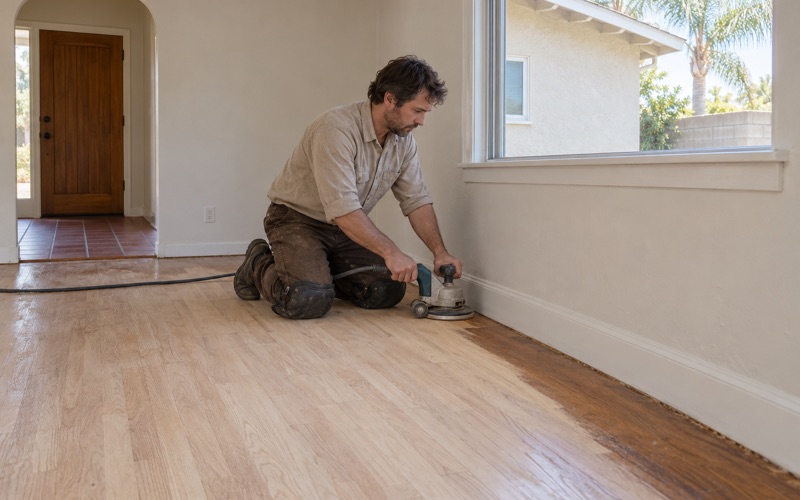
Solid hardwood that was wet from a clean-water source for a short time, and that cupped without buckling, often comes back. With the source stopped, air moving and the right patience, many floors flatten as their moisture content returns to normal, after which a sanding and refinish removes the remaining unevenness and any white water rings in the finish.
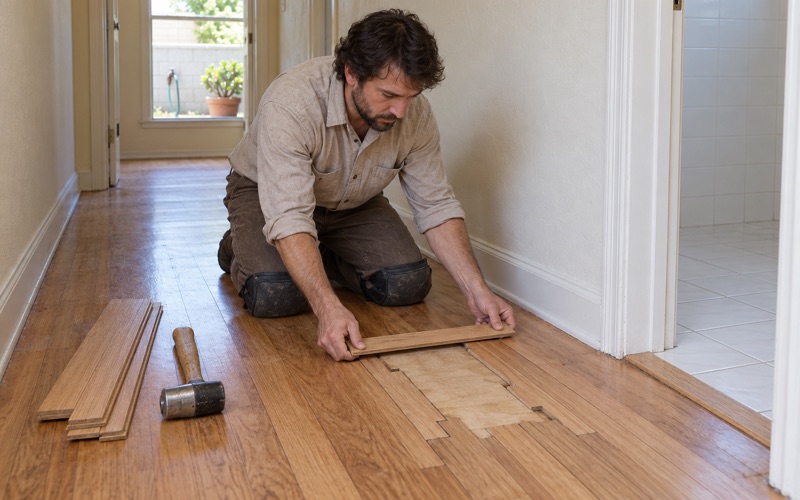
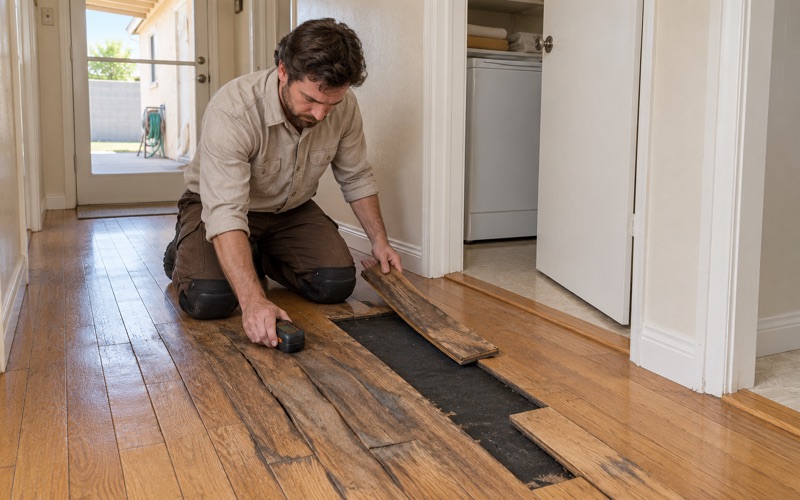
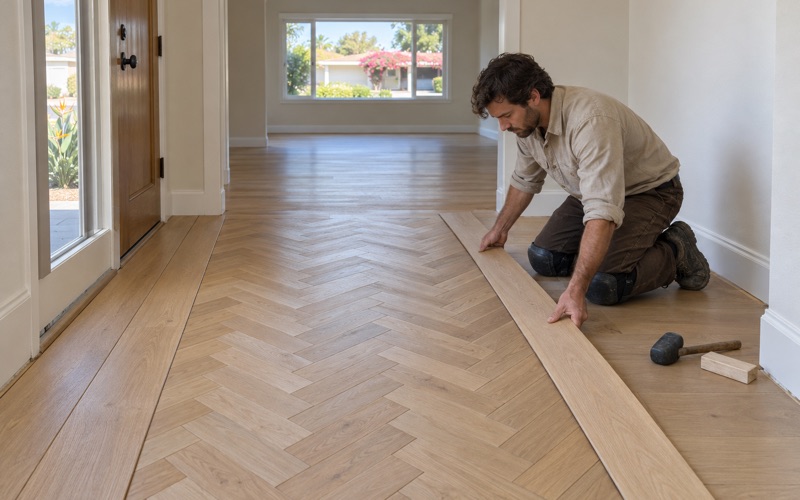
Isolated damage can often be handled with a board replacement or a weave-in repair, where new boards are threaded into the existing floor so the patch does not read as a square. That approach keeps sound flooring in place and limits the new material to the area that actually failed.
What Usually Has to Come Out
Buckled sections, boards that stayed wet long enough to show mold or rot, and flooring soaked by outside floodwater are usually removal candidates. Engineered flooring whose core construction has delaminated rarely recovers, because the layers separate once the adhesive between them gives way, and no amount of drying rejoins them.
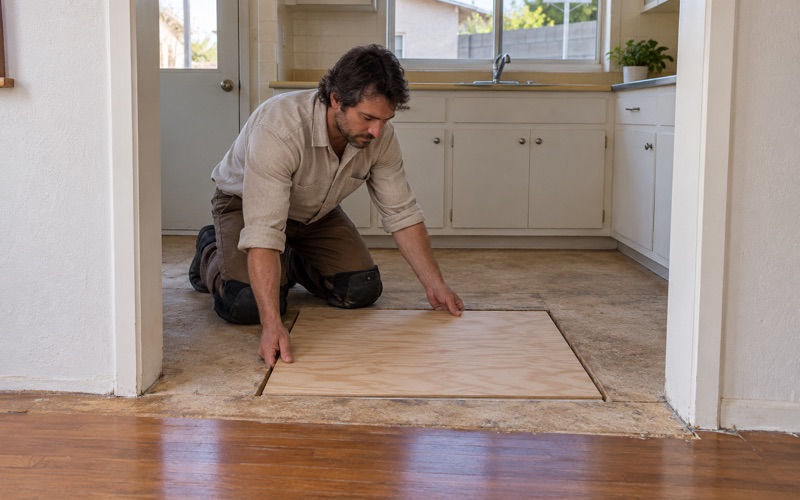
The subfloor decides the rest. Particleboard decking that swelled does not return to its original thickness, and a plywood subfloor that stayed wet can soften or delaminate. We probe for soft spots and check the framing below before pricing a new finish floor, so the new boards are not fastened to something that will fail again.
Planning Floor Work in Artesia
Most houses here are older than the floors in them. Of the city’s 4,727 housing units, 76.2 percent were built before 1980, and 68.0 percent are one-unit detached houses. That age profile shapes what we find under a floor and how we handle it, whether the job is a refinish, a new install or a repair after water.
Older Houses, Careful Demolition
In pre-1978 housing we follow lead-safe work practices under the EPA Renovation, Repair and Painting rule, because sanding and removal disturb old paint on baseboards, thresholds and trim. Old 9x9 floor tile and black mastic under a covering are treated as a possible asbestos question, and nothing gets sanded or scraped until that has been answered.
Finish choices follow the rules of the South Coast air basin. We use products that meet the 275 g/L wood-coating limit under SCAQMD Rule 1113, which in practice means a waterborne polyurethane or a compliant oil-modified or hardwax oil finish, chosen for how the room is used and the sheen level you want.
Choosing Floors With Water in Mind
No floor is floodproof, but some recover better than others. Solid oak strip flooring can often be sanded several times, which gives it room to come back after a leak. An engineered plank with a thick wear layer offers a similar margin, while a thin wear layer leaves little to work with once cupping has been sanded out.
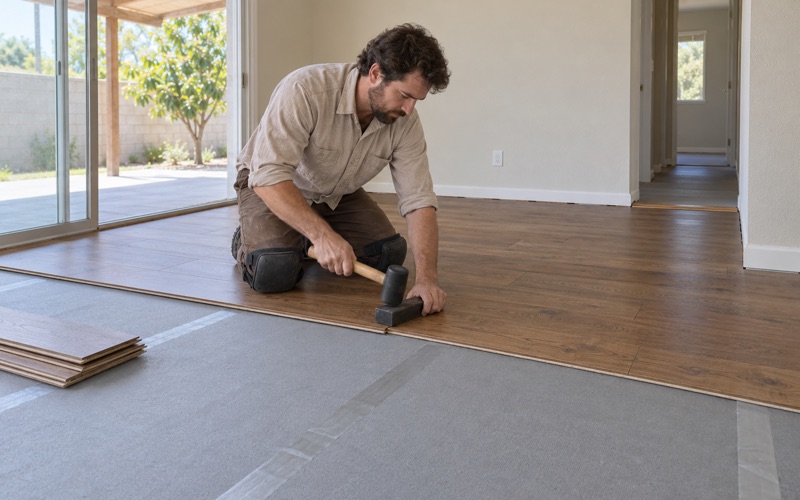
Installation method matters as well. A nail-down floor can have damaged sections removed and woven back in, a glue-down floor ties the wood to whatever is beneath it, and a floating installation can trap water under the whole room. We walk through those tradeoffs against how each room is used before anything is ordered.
Reading a Scenario Map Sensibly
The six-foot figure in the hazard plan is a planning tool for the city, not a forecast for your living room, and the plan itself says the probability of a dam failure affecting the city is unknown. We would not pull up a sound floor because of it, and we would not tell anyone to skip moisture testing because of it either.
The city is preparing an update to its hazard plan, and its update page again lists dam failure, flood and windstorm among the hazards it covers. Until that draft is released, the 2020 plan is the record. We use it the way it was written: as a reason to measure moisture, document damage and choose materials that can be repaired.
- 20+ Years on Hardwood
- Written Moisture Readings
- Lead-Safe Work Practices