Bellflower Wood Flooring has spent more than 20 years on wood flooring in Hawaiian Gardens and the surrounding part of Los Angeles County, and a large share of that work starts the same way: someone has just become the owner of a house they did not build. The keys are new, the floor is not, and the first question is what the floor actually needs.
We answer that question before we quote anything. A floor that looks tired can often be repaired or refinished, and a floor that looks fine can hide moisture, loose boards or an old adhesive layer that changes the whole plan. Our job is to separate the two, write down what we found, and price the work that the floor calls for rather than the work that is easiest to sell.
This page is written for new owners in that position. It covers how we read a floor you have inherited, how we decide between repair, refinishing and replacement, and how to fit the work around a move-in so the house is usable when you need it.
Six Houses on Claretta Street and a Change of Ownership
What the City’s Notice Describes
On July 27, 2026, the City of Hawaiian Gardens signed a Notice of Exemption for a project titled the 6-Unit Residential Condominium Conversion Project. It describes a proposal to convert six existing detached single-family dwellings at 22001 Claretta Street into six condominium units, on a site zoned R-3, Intermediate Density Residential.
The notice states that the project conforms to the parking, setback and open space rules for a condominium conversion. It is exempt under the existing facilities category because it divides existing residences into common interest ownership where no physical changes occur, with no physical development tied to the request.
Why No Construction Matters Underfoot
That phrase, no physical changes, is the part that matters for flooring. A conversion of this kind changes how a house is owned, not how it is built. Whatever floor is in each house on the day the paperwork changes is the floor the next owner receives.
New construction arrives with new subfloors and new finish flooring. A converted house arrives with its history intact, including any repairs, patches and coverings added over the years. We do not know the age or condition of the Claretta Street houses, and we would not guess. The point is general: when ownership changes without a rebuild, the floor has to be assessed rather than assumed.
A Pattern That Fits the City’s Housing Stock
Hawaiian Gardens is a small city, about 0.945 square miles of land, and most of its homes were built long ago. Census figures show 73.7 percent of the city’s housing units were built before 1980, and detached houses make up 44.8 percent of all units.
With 43.8 percent of occupied units owner-occupied, a great many owners here live in houses that predate them by decades. The Claretta Street notice is one documented case of ownership changing inside that existing stock, but the floor question it raises applies to any older house changing hands in the city.
It also contrasts with the city’s for-sale projects built from the ground up, such as the 18-unit condominium planned at 21821 Hawaiian Avenue on five consolidated residential parcels. A buyer there receives new floors. A buyer of an existing house receives whatever floor is already in place, which is where our assessment starts.
Looking for wood-flooring closer to South Gate? See Wood-Flooring Services in South Gate.
Reading the Floor You Inherit in an Older Home
Start With the Surface You Can See
We begin with a walk-through of every room, looking for cupping, crowning, buckling, board gaps, squeaks and nail pops. Each of these points somewhere specific. Cupping usually means moisture from below, gaps usually mean the boards have dried and shrunk, and nail pops often trace back to fasteners working loose over years of foot traffic.
We also read the finish itself. White water rings, a milky finish, peeling or tacky polyurethane and pet urine stains each call for a different response. Some sit in the finish and come out with sanding. Others have gone into the wood and need a board replacement to fix properly.
Look Under Carpet and Linoleum
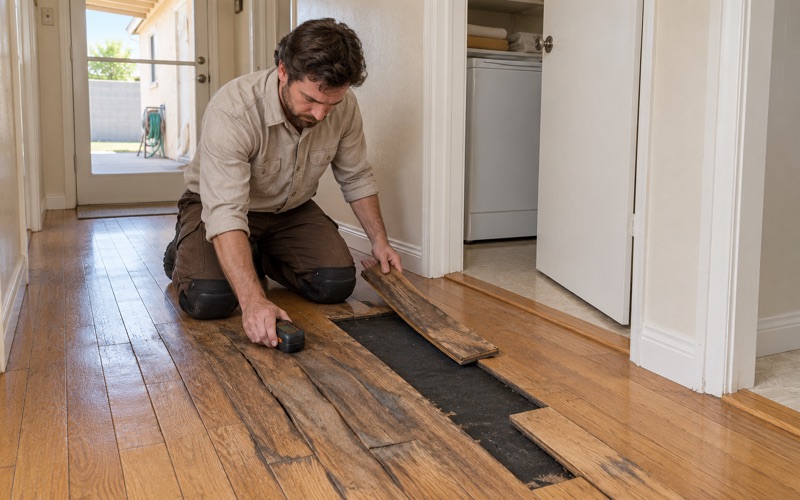
Many older houses carry wood beneath carpet or linoleum that later owners laid over it. When we find oak strip flooring under a covering, we lift a section and assess it board by board before anyone talks about a full replacement. Carpet tack strip holes, staple patterns and old adhesive are all repairable in most cases.
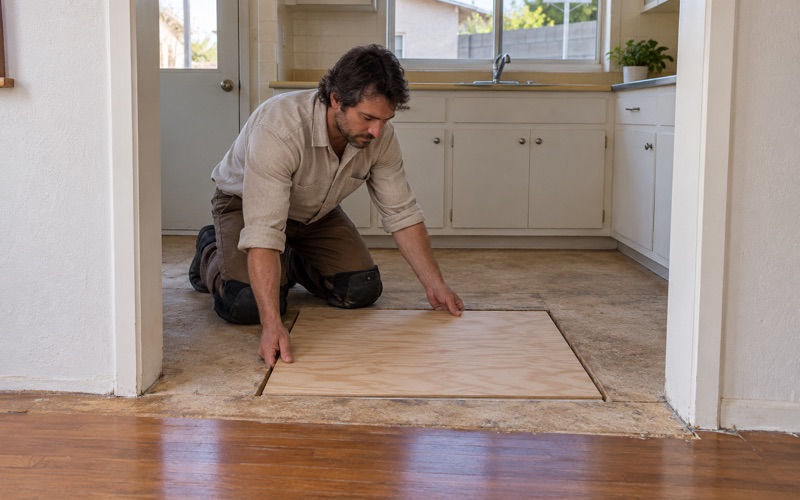
We also look for old floor furnace openings and floor registers that were covered rather than closed. We close those with framing and woven-in boards so the patch disappears into the floor, instead of leaving a plywood square under a rug.
Measure Moisture and Check the Structure
Before we order material, we take moisture content readings in the wood with a wood moisture meter. Where a floor sits over concrete, we test the concrete too, using an ASTM F2170 in-situ relative humidity test or a calcium chloride moisture test depending on the job. The readings are written down and handed to you.
Soft spots, sagging and bounce get traced to the subfloor and framing before we price a finish floor. A new floor laid over a sagging joist or a failing plywood subfloor inherits the problem, so we find out whether sistering a joist or replacing decking belongs in the scope first.
Treat Old Tile and Paint as Questions First
Older houses can hold 9x9 asbestos floor tile or black mastic under a later floor. We treat either as a possible asbestos question and arrange an asbestos survey before anything is sanded or scraped, in keeping with SCAQMD Rule 1403.
In houses built before 1978 we follow lead-safe work practices under the EPA Renovation Repair and Painting rule. Painted trim, shoe molding and old thresholds are handled with containment and cleanup rather than dry sanding into open rooms.
Repair, Refinish or Replace After You Take Title
When Repair Is Enough
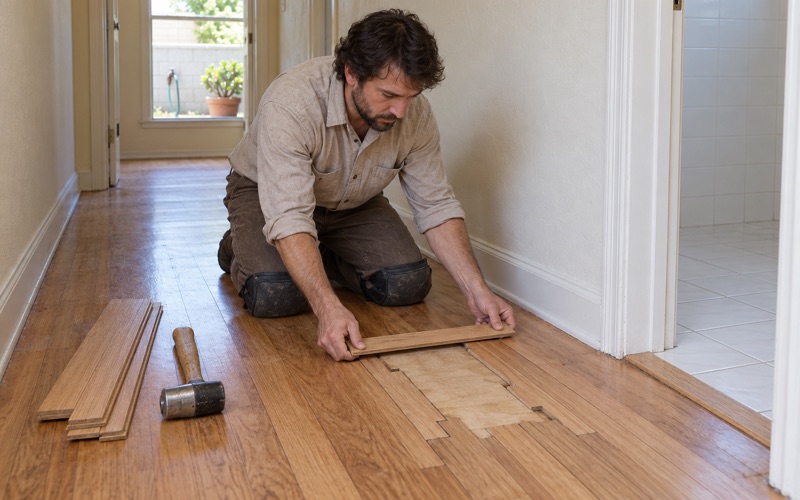
A floor with sound boards and a few damaged areas usually needs repair, not replacement. We cut out stained, split or water-marked boards and weave in replacements that match the width and species, then blend the finish so the repair does not read as a patch.
If water damage is part of the story, we trace it to the source before replacing anything and document the area with photos and moisture readings an insurance adjuster can use. Replacing boards over a leak that is still active only buys a second repair.
When Refinishing Makes Sense
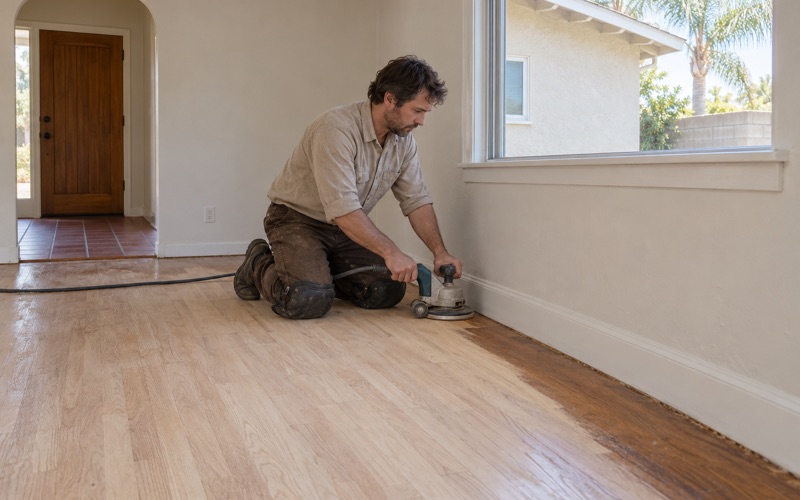
If the wood is solid and the wear is in the finish, a screen and recoat can restore a floor for far less than sanding. When the wear has reached the wood, or the floor has turned orange oak or picked up a blotchy stain, we run a full sand with a drum sander, edger and orbital sander through a proper grit sequence, using a dustless sanding system.
Every finish we apply is legal in the South Coast air basin under the SCAQMD Rule 1113 wood coatings VOC limit of 275 g/L. We walk you through waterborne polyurethane, oil-modified polyurethane and hardwax oil finish options, along with sheen level, before the first coat goes down.
When Replacement Is the Honest Answer
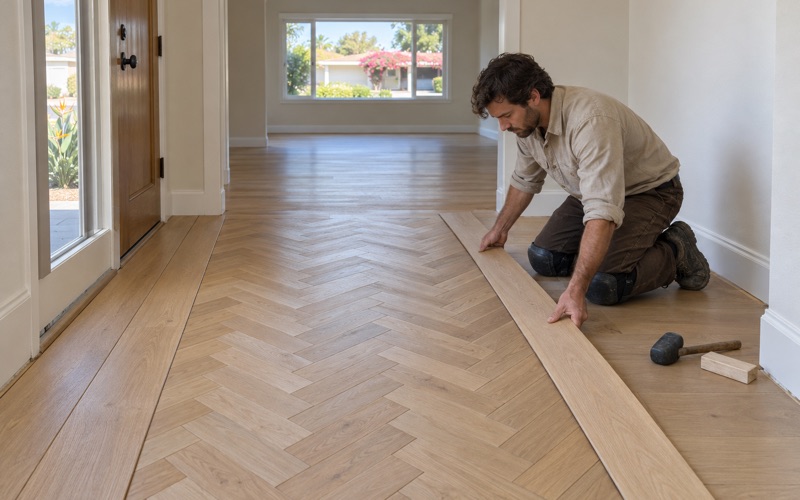
Some floors have been sanded too many times, damaged too deeply, or covered with materials that cannot be saved. Then we talk through site-finished hardwood, prefinished hardwood and engineered flooring, comparing wear layer thickness, engineered core construction and Janka hardness rating across white oak, red oak and hickory.
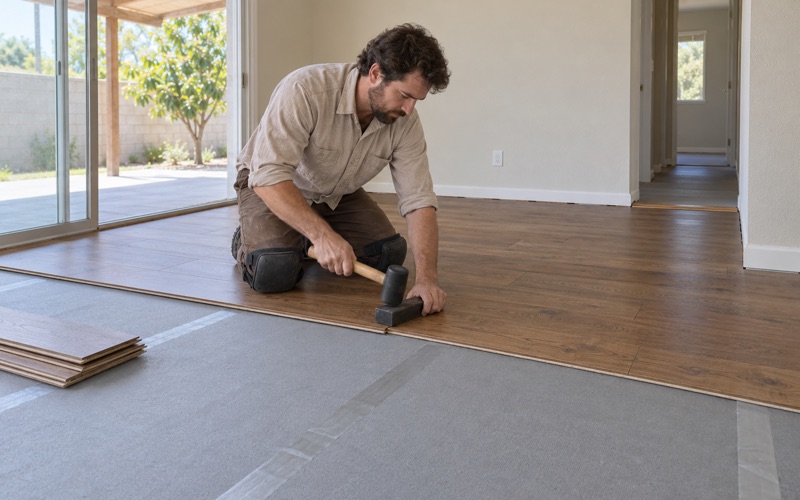
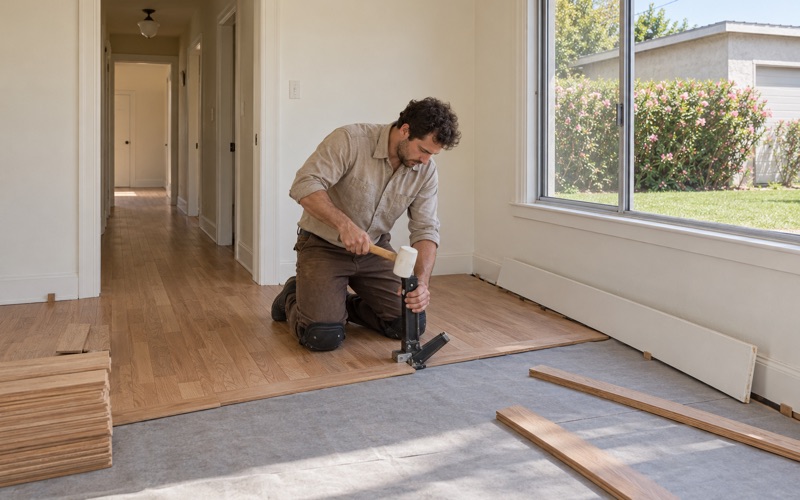
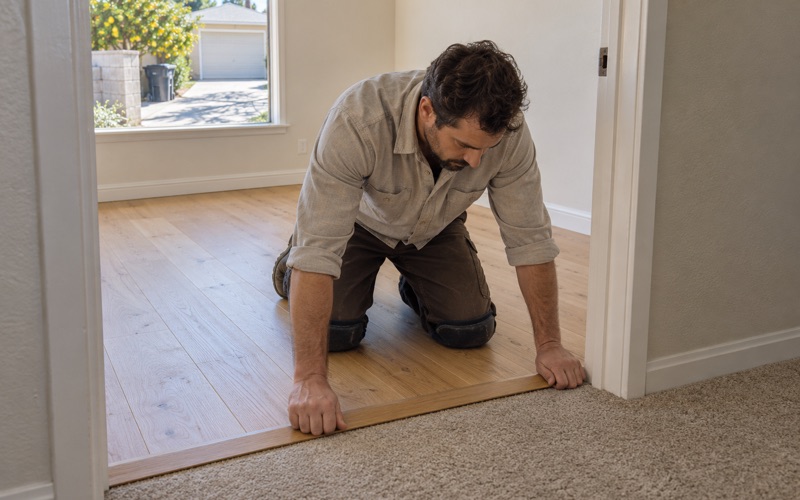
Installation follows NWFA installation guidelines, whether the floor goes down as a nail-down installation with cleat nails or flooring staples, a glue-down installation or a floating installation. We leave the correct expansion gap and finish transitions with reducer strips and T-molding where rooms meet.
For rooms where wood is a poor fit, we will say so and discuss wood-look vinyl plank as an alternative. Whatever is chosen, composite products are checked as CARB Phase 2 compliant before they come into the house.
Stairs Priced on Their Own
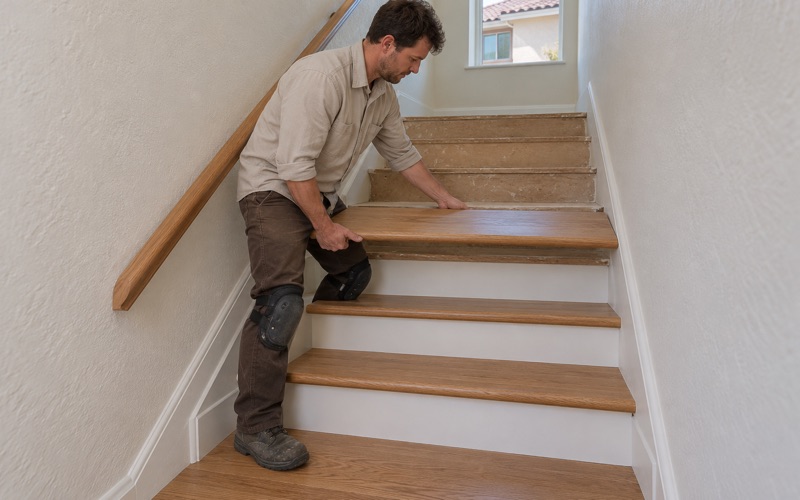
Stairs in an older house often need more than the floors around them. We price each stair tread and stair riser individually, including stair nosing, so you can see what the staircase costs instead of finding it folded into a square-foot figure.
Worn treads often sand back well, while cracked or split ones are better replaced so every step matches. Where the stairs meet the upper floor, we fit the nosing so the transition sits flush and does not become a trip point on the way down.
Scheduling Floor Work Around a Move-In
Do the Floors Before the Furniture
The easiest time to work on a floor is before anything is on it. If you can hold off moving in for a short window, sanding, repairs and finishing go faster, dust control is simpler, and there is no furniture to move twice.
When a delay is not possible, we phase the work room by room so the parts of the house you need stay usable. That takes longer overall, and we tell you up front how the sequence will run.
Allow for Acclimation and Cure
New wood needs acclimation in the house before installation, and the length depends on the moisture readings rather than a fixed calendar. Finishes need cure time before rugs and heavy furniture go back. We give you a written schedule showing when each room is walkable and when it can be furnished.
We also plan around the other trades a new owner tends to call in the same month. Painting, electrical work and cabinet changes are better finished before the final finish coat goes on, so a ladder or a dropped tool does not mark a floor that has only just cured.
Get the Scope in Writing
Every job gets a written estimate listing what we found, what we recommend and why. If you are buying a house to rent it out, the same estimate and a final invoice give you a clear record of the floor’s condition and the work done at the start of your ownership.
Keep that paperwork with the house rather than with the invoice pile. That record is useful long after the job, because it tells the next person who assesses the floor exactly what was repaired, refinished or replaced, and when.
- 20+ Years on Hardwood
- Written Moisture Readings
- Lead-Safe Work Practices