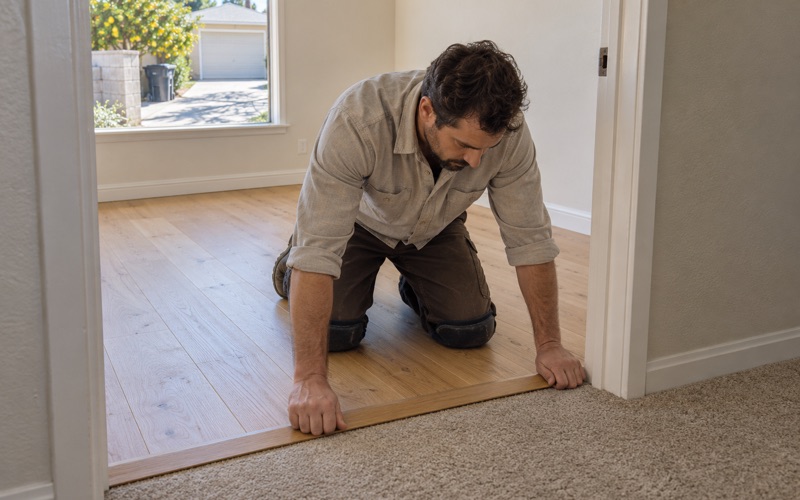
Bellflower Wood Flooring brings more than 20 years of work to wood-flooring in Lomita, and a good share of the calls we get here start at a front door or a patio slider. A board that cups along the threshold, a finish that turns milky near the entry, or a strip of flooring that lifts after a wet week usually follows heavy rain rather than a plumbing failure.
Our first job on those calls is finding where the water came from before we price anything. We take moisture readings in the wood and in any concrete beneath it, write every number down, and photograph what we find, so an adjuster or a landlord has a record to work from instead of a guess.
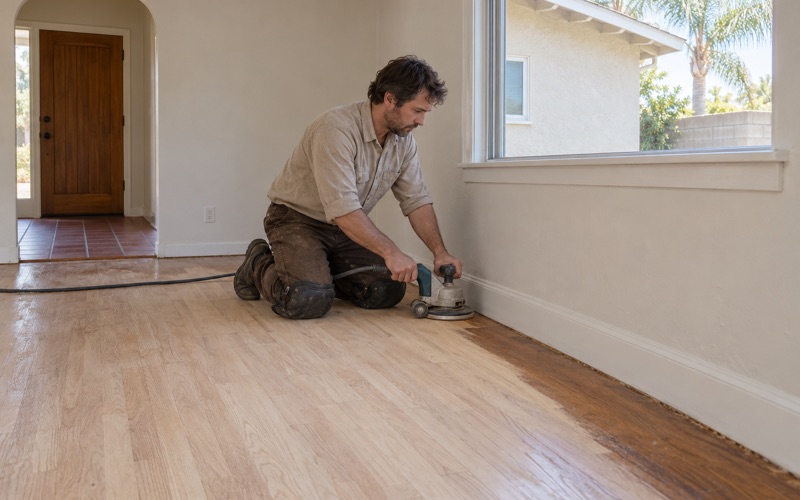
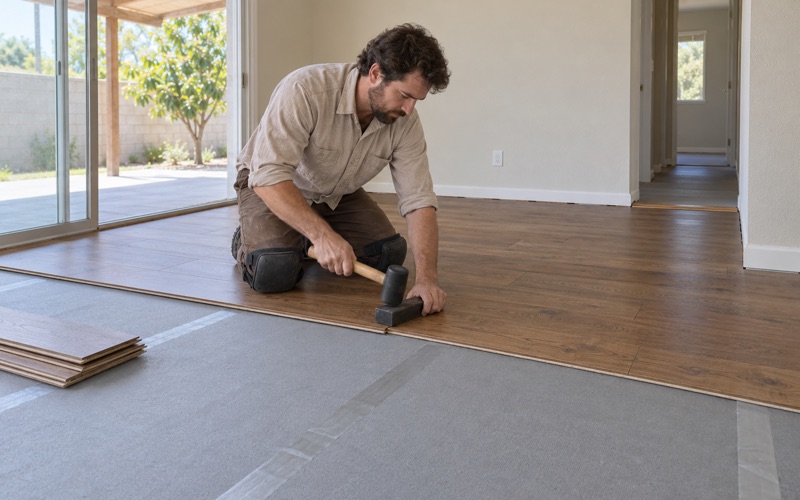
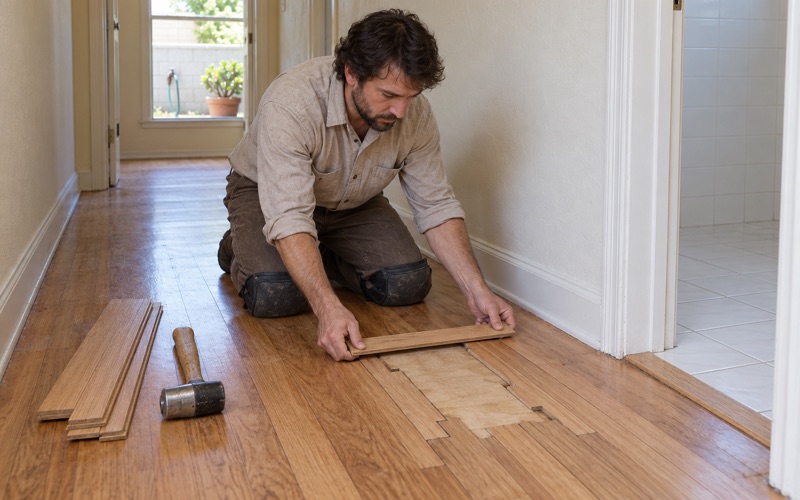
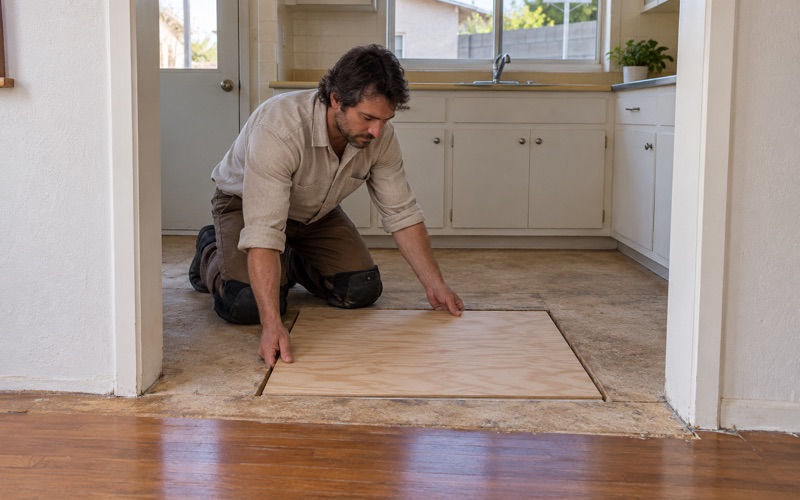
From there the work might be a handful of boards woven into the existing field, a full sand and refinish, or a new floor laid over a subfloor that has been dried and repaired. Whichever it turns out to be, we explain the reason for it before any work starts.
Street Flooding and the City’s Stormwater Plan
What the City Says About Downtown
Lomita’s flood problem is mostly a street problem. In a 2023 request for engineering design services, the city wrote that bioretention along Narbonne Avenue will mitigate existing localized flooding that frequently occurs in the downtown area of Lomita. That is the city describing its own streets and gutters, not a line drawn on a floodplain map.
The project area runs south from City Hall on Narbonne Avenue to Lomita Boulevard, then along Lomita Boulevard between Lucille Avenue and Woodward Avenue. The city frames it as a stormwater capture and water-quality project for those downtown streets, not as a statement about any particular building beside them.
Where the Rain Goes
According to the city’s 2024 infrastructure report, stormwater here is collected by catch basins, inlets and storm drain pipes and generally drains west to east into Los Angeles County Flood Control District facilities. From there it moves toward the Wilmington Drain, Machado Lake and the Los Angeles Harbor.
The city owns many of the catch basins and smaller laterals, while County Public Works maintains most of the main lines. For a homeowner that split matters in one practical way: when a gutter backs up in a storm, the fix belongs to a public agency, but the water sitting at your door is yours to manage.
The Project in Brief
The design request describes diverting about 5.6 acre-feet of stormwater from three County storm drains downtown into an infiltration gallery under the city-owned parking lot on Narbonne Avenue and a series of 34 drywells under Lomita Boulevard. It also calls for 8,000 square feet of bioretention areas and 45 new shade trees.
The city was pursuing U.S. Army Corps of Engineers funding through the Section 219 program, and the request described that funding as pending. We have not confirmed where the project stands since 2023, so we plan floor work around the streets as they drain today.
Drains the City Has Flagged
The same 2024 report says that although Lomita is not subject to flooding from FEMA floodways, localized flooding can still occur during large rain events because existing inlets, culverts, catch basins, pipes, curbs and gutters are inadequate. It lists four storm drain deficiencies: Eshelman Avenue at 262nd Street and Appian Way, Pennsylvania Avenue from about 251st to 254th, the western end of 256th Street, and Lomita Boulevard at Pennsylvania.
Those are drainage lines and street locations, not a list of flooded houses. We mention them because a wood floor near an exterior door is the first surface inside to take the hit when water sits in the gutter longer than it should.
Looking for wood-flooring closer to Hermosa Beach? See Wood-Flooring Services in Hermosa Beach.
How Runoff Reaches a Floor
Thresholds, Sliders and Sills
Most water we trace in a Lomita house did not rise through the ground. It came across a threshold, under a slider track, or past a door whose sill sits too close to a patio or walk that slopes toward the wall. Runoff that pools at the curb can also creep up a driveway apron and linger there.
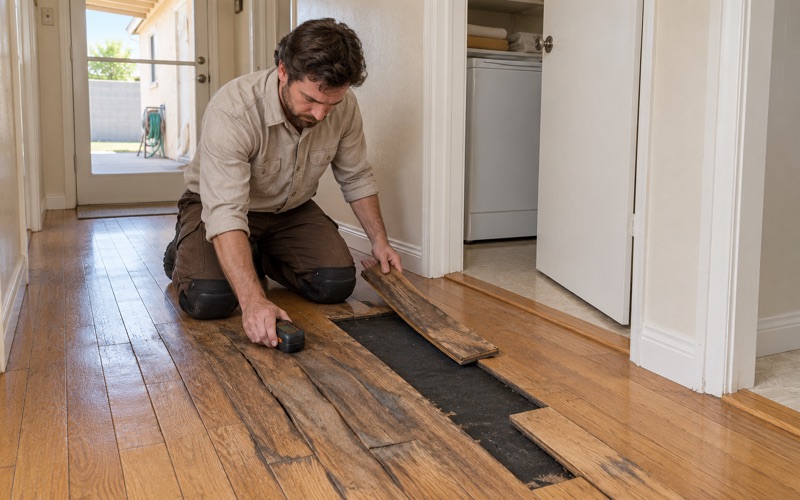
Wood takes on water through its end grain first, so the boards at a doorway show damage before the rest of the room does. The usual signs are cupping along the entry, dark staining at board ends, and a finish that has turned white or cloudy in a band just inside the door.
Older Houses and Shifting Details
About 78.9 percent of Lomita’s housing units were built before 1980, and older houses tend to have door sills, weatherstripping and exterior grades that have moved over the decades. A patio poured after the house was built can sit higher than the original plan intended, and a walk can settle so it tips toward the wall.
None of that is a defect in the floor itself, but it decides whether a new floor survives its first wet winter. Before we install wood near an exterior door, we look at how the ground outside is shaped and whether the sill still sheds water outward.
Keeping Water Out Before a Storm
The city offers sandbags to residents at City Hall during heavy rain, while supplies last. A short row laid across a low door or garage entry is a simple way to keep street runoff off a finished floor when a big storm is forecast.
Inside, a rubber-backed rug left against a door can trap water under it for days. After a storm, pull mats and rugs away from entries, wipe up standing water right away, and open the house to let it dry. The sooner the surface dries, the less water the boards take in.
Checking a Wood Floor After Water Gets In
What to Look For in the First Days
Cupping, where board edges sit higher than the centers, means the underside took on more moisture than the top. Crowning is the reverse and often shows up when a cupped floor is sanded flat before it has dried. Buckling, where boards lift off the subfloor, means the floor had nowhere left to expand.
White water rings and a milky haze usually sit in the finish rather than the wood. Black or gray staining at seams and board ends means water reached the wood fibers, and those boards will likely need to come out rather than be sanded.
Measuring Before Deciding
We use a wood moisture meter to take moisture content readings across the wet area and in dry rooms for comparison. The dry rooms set the baseline, and no repair is scheduled until the wet area comes back toward them. Where there is concrete under the floor, we test it too, with a calcium chloride moisture test or an ASTM F2170 in-situ relative humidity test.
Every reading goes into a written record alongside dated photos. For an insurance claim, that record shows the adjuster where the water entered, how far it traveled across the room, and what the numbers were on each visit.
Repair, Refinish or Replace
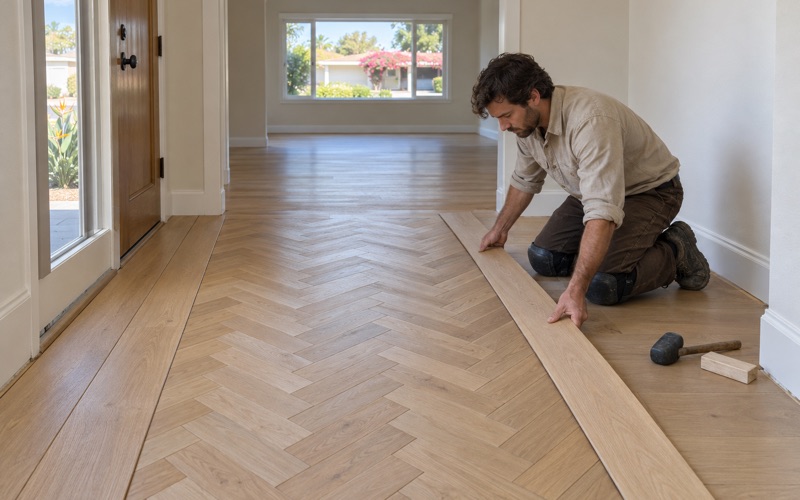
A floor that cupped and then dried back often flattens on its own and needs only a sand and refinish. A few stained or split boards at a doorway can be cut out and replaced with a weave-in repair, so the new boards run into the existing field instead of forming a visible patch.
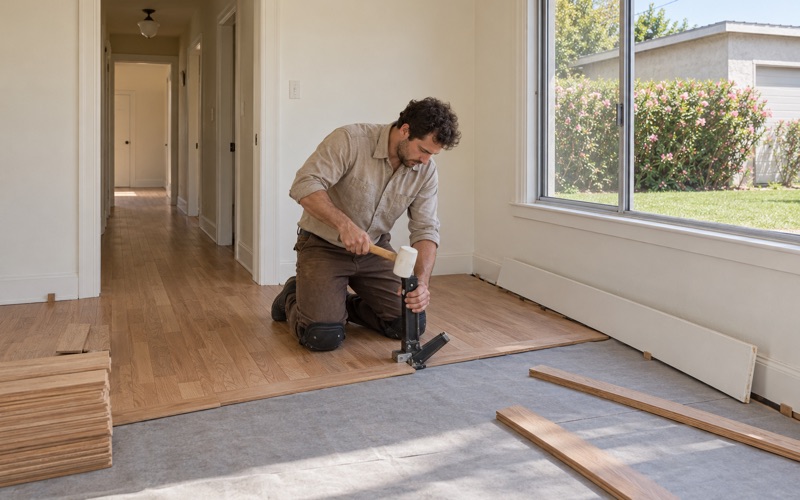
Where the subfloor stayed wet, we open the floor and check the plywood or board subfloor and the framing below it for softness before pricing a finish floor. Laying new wood over damp decking is how a water repair ends up failing twice.
Planning Floor Work in Lomita
Older Homes and Hidden Materials
Because so much of Lomita’s housing predates 1980, we treat lead as an open question on any house built before 1978 and follow the EPA Renovation, Repair and Painting rule. Old 9x9 tile or black mastic found under a floor is handled as a possible asbestos question, and nothing is sanded or scraped until it has an answer.
Under carpet or linoleum we sometimes find wood worth keeping. We assess it board by board before anyone talks about a full replacement, because a few damaged boards near a door rarely justify tearing out an entire room.
Finishes Near an Entry
The finishes we apply are chosen from products legal in the South Coast air basin under the SCAQMD Rule 1113 wood-coating limit of 275 g/L. Waterborne polyurethane dries quickly and stays clear, while oil-modified polyurethane gives a warmer tone but needs a longer cure before furniture goes back.
Near an entry that has already seen water, we often suggest a finish that can be screened and recoated. That way the high-traffic band by the door can be refreshed on its own schedule without sanding the whole room back to bare wood.
Inspections, Rentals and Scheduling
Building and safety services for Lomita, including plan check, permits and inspection, are provided by Los Angeles County Public Works under contract, from the office at 24320 S. Narbonne Avenue. When a water repair grows into framing or plumbing work, that office is the one to ask.
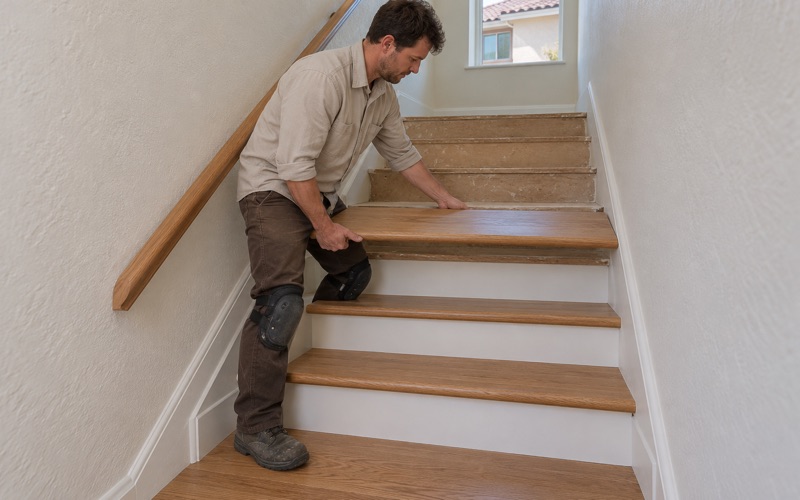
For landlords turning over a rental, we write estimates and invoices that hold up as records, and we try to schedule drying and repair away from the rainiest weeks. Stairs are priced per tread and riser rather than folded into a square-foot number, so a staircase near a wet entry is quoted on its own terms.
- 20+ Years on Hardwood
- Written Moisture Readings
- Lead-Safe Work Practices