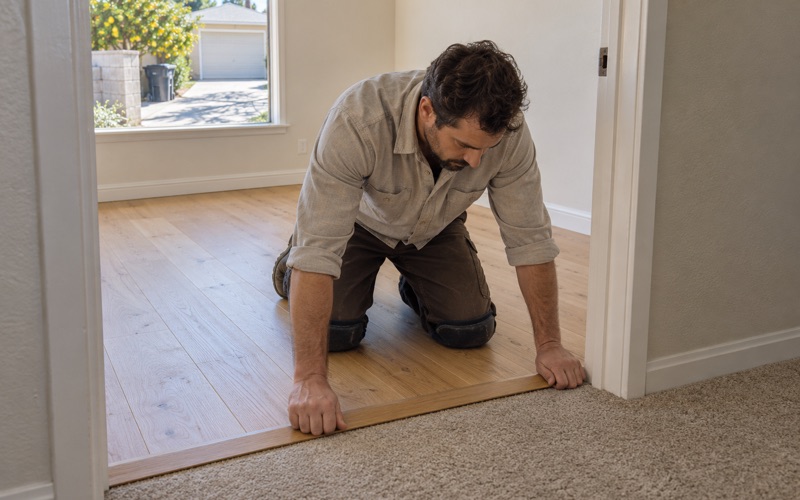
Bellflower Wood Flooring brings more than 20 years to wood-flooring in Santa Fe Springs, and the first thing we look at on a job here is not the floor at all. It is the path from the driveway to the front door, because whatever rides in on shoes, boxes and tool bags ends up pressed into a fresh finish.
Most of our work in town falls into three kinds of jobs: refinishing a floor that has been hidden under carpet for decades, repairing boards damaged by water or old heating openings, and installing new solid or engineered hardwood. Each one starts with a moisture reading and a plain look at the subfloor before we put a number on paper.
What follows explains how we handle a house in a city that grew up around oil fields, why we treat entry protection as part of the job rather than an afterthought, and how we decide what an older floor actually needs.
Floors in a Town That Grew Up Pumping Oil

The Boom Came First
Santa Fe Springs was an oil town before it was a residential city. In 1921 the Union-Bell well blew in as a 2,500-barrel gusher, and through the 1920s the field produced as much as 345,000 barrels a day. The city itself did not incorporate until May 15, 1957, decades after the derricks went up.
That order of events still shapes the map. According to the city’s housing element, less than ten percent of its nine square miles is designated residential, and neighborhoods sit mostly in the western portion with small pockets along the eastern edge. Homes here often share their surroundings with industry in a way that few nearby suburbs do.
Wells Inside a Neighborhood
A July 23, 2015 report in the Los Cerritos Community News described BreitBurn Energy Partners operating 20 well sites inside the Villages at Heritage Springs, the neighborhood off Telegraph Road between Norwalk and Bloomfield. That is not history from the boom years. It is a description of oil work running among houses within recent memory.
The same report covered a leak on the 10500 block of Magnolia Place. BreitBurn representatives attributed it to a pipeline blocked by sand that let extreme pressure build until a gasket burst. Oil and water sprayed over a home, its plants and trees, and the cars parked outside. The homeowner told the paper it was his second such incident.
Cleanup was handled by a contractor that excavated and bagged the affected vegetation, coordinated with the city’s Environmental Protection Specialist. The report described damage to the yard, the house exterior and the vehicles. It did not describe anything inside the home, and we do not claim to know what operates in that neighborhood today.
Why a Flooring Crew Cares
For floor work, the lesson from that report is practical rather than dramatic. Outdoor surfaces in parts of this city can carry residue that is invisible until it meets a freshly sanded board or a wet coat of polyurethane. A driveway, a walkway or a car tire can be the source, and nobody inside the house would think to mention it.
So we treat the exterior approach to every Santa Fe Springs job as part of the work area. We look at where the crew will park, where material will be staged, and which door gives the shortest, cleanest route to the room we are working in.
Looking for wood-flooring closer to Lynwood? See Lynwood Wood-Flooring.
Keeping Outdoor Residue Off a New Finish
Entry Protection From Day One
Before a single board is sanded, we lay a protected path from the working door to the room. That means walk-off mats outside, a clean runner inside, and shoe covers that get changed when a crew member steps back in from the truck. Doorways into rooms we are not touching are sealed so dust and grit stay put.
We also limit traffic. One door is used for the whole job, tools are wiped before they come in, and boxes of flooring are opened on a clean surface rather than on the driveway. None of this is complicated, but skipping it is how a clean refinish ends up with specks and dull patches.
Why a Fresh Finish Is Vulnerable
A newly sanded floor is bare wood with open grain, and it takes up whatever lands on it. Oily film or fine grit trapped under the first coat can keep the next coat from bonding, which later shows up as peeling polyurethane, tacky spots or a milky patch that will not buff out.
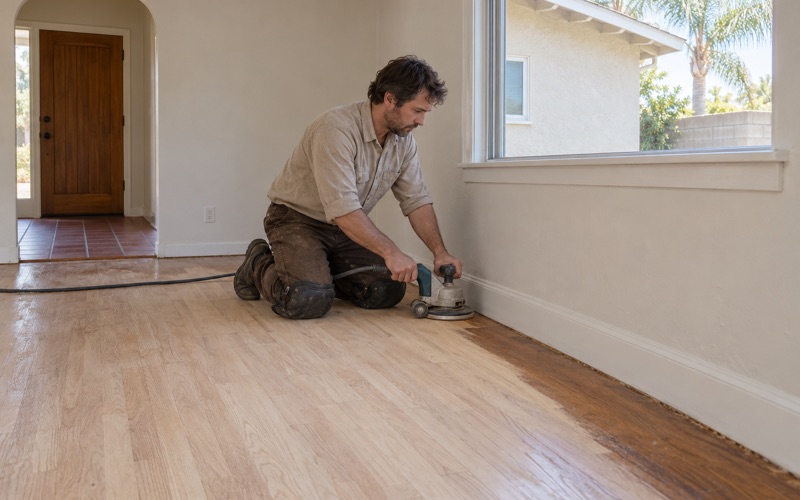
The same risk applies to a screen and recoat, where we abrade the existing finish and lay down a fresh coat. That second coat depends on a clean, dry surface. If the floor is contaminated between steps, we clean it and test adhesion before going on rather than trapping the problem under more finish.
The First Weeks After We Leave
Waterborne polyurethane and oil-modified polyurethane both need time to cure fully, even after the floor feels dry underfoot. During that window, grit from outside acts like sandpaper on the new surface. We leave you with the cure schedule for the product we used and a plain list of what to avoid.
The simplest habit is the best one: keep a good mat at each entry and take shoes off inside. Felt pads on furniture legs, no area rugs until the cure period passes, and a dry microfiber mop instead of a wet one will protect the finish far longer than any product sold for the purpose.
Assessing an Older Santa Fe Springs Floor
A City Built Mostly in the 1950s
Of the 5,927 housing units in Santa Fe Springs, 45.3 percent were built during the 1950s, and 69.2 percent predate 1980. Among owner households, 84.2 percent live in one-unit detached houses. In practice, a typical call from a homeowner here is about a single-family house that is roughly seventy years old.
Houses of that age have usually been through several rounds of floor covering. Carpet, linoleum, sheet vinyl and tile may be stacked in different rooms, each laid by a different owner. Our job is to find out what is actually under all of it before anyone talks about tearing it out.
What Is Under the Carpet
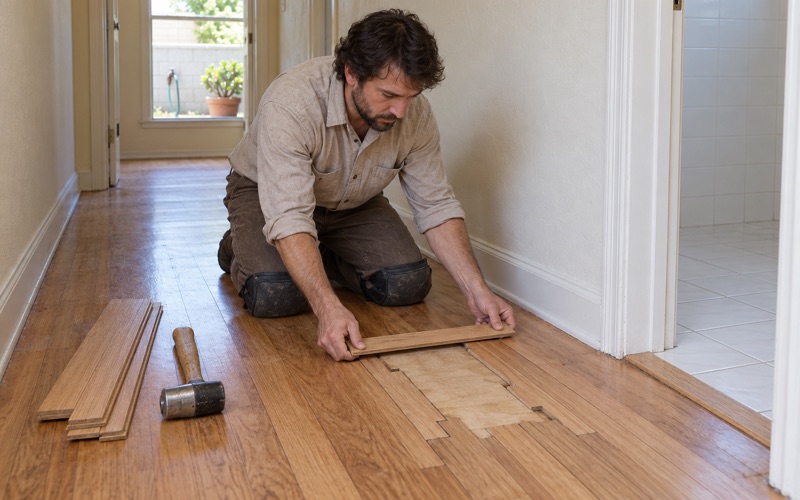
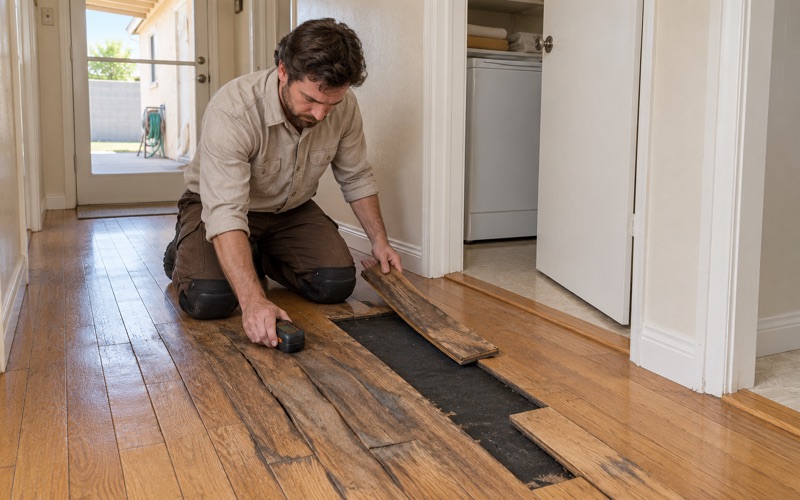
When we find wood under carpet or linoleum, we assess it board by board. Carpet tack strip holes, staple marks, pet urine stains and board gaps are all things a sanding and a few weave-in repairs can often handle. We quote a full replacement only after the existing boards have been checked and ruled out.
If we find old tile or black mastic, including the 9x9 floor tile common in postwar houses, we treat it as a possible asbestos question and stop before sanding or scraping. Because most of these houses were built before 1978, we also follow lead-safe work practices under the EPA Renovation, Repair and Painting rule whenever painted surfaces are disturbed.
Subfloor, Moisture and Old Openings
Soft spots, sagging and bounce get traced to the subfloor and framing before a finish floor is priced. A sagging joist or loose decking will show through any new floor, so we find it first. We measure moisture content in the wood with a meter, and in any concrete we use an in-situ relative humidity test, writing down every reading.
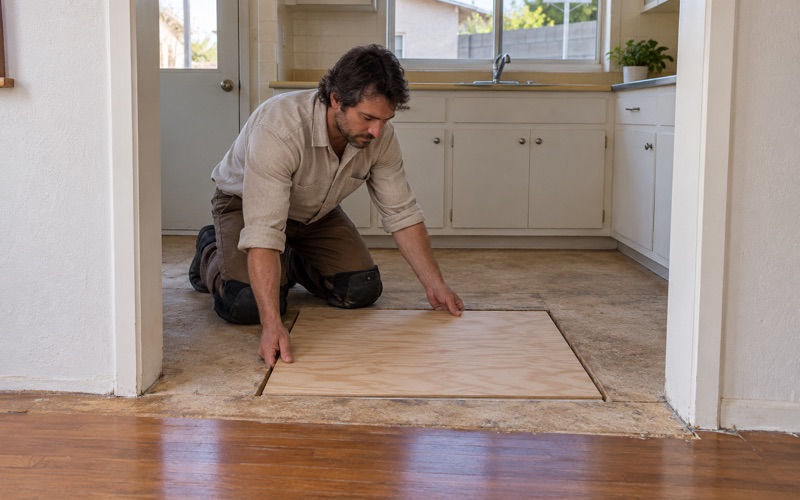
Many houses from this era were heated through the floor. Where an old floor furnace or register opening has been covered with plywood and a rug, we frame the opening properly and weave matching boards into the surrounding field so the repair disappears into the floor rather than sitting on top of it.
Judging What Is There
We assess a floor for what we can see and measure: cupping, crowning, buckling, squeaks, finish failure and water damage. We do not guess about what the ground under a house might hold, and we do not dress up a routine refinish as something more serious to justify a bigger price.
When water has caused the damage, we trace it back to its source first. We document the floor with photos and moisture readings that an insurance adjuster can use, and if a plumber has had to repair or reroute a leaking line, we put the floor back properly once that work is done.
Planning Floor Work in Santa Fe Springs
Choosing a Finish
Santa Fe Springs sits within the South Coast Air Quality Management District, and under SCAQMD Rule 1113 wood coatings are limited to 275 grams of VOC per liter. We choose finishes from products legal to apply in the basin, whether that means a waterborne polyurethane, an oil-modified product that meets the limit, or a hardwax oil.
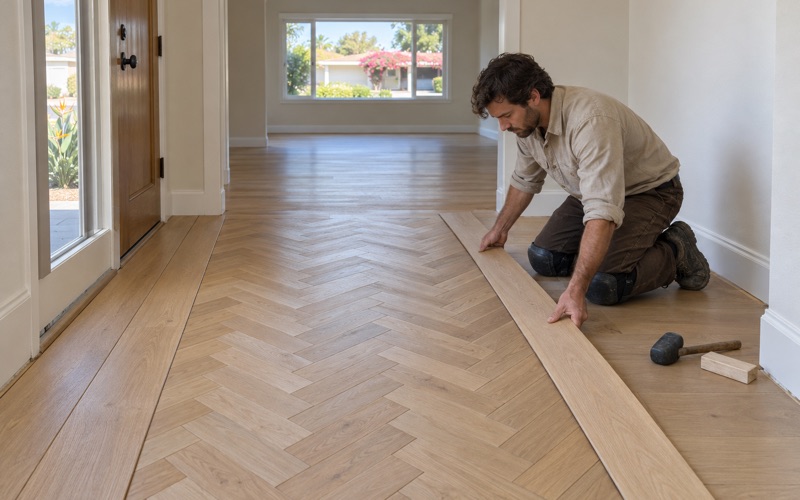
The choice also depends on traffic and taste. A matte or satin sheen hides the fine scratches that come with daily entry traffic better than gloss does. Red oak and white oak take stain differently, and a test patch on the actual floor avoids the blotchy stain and orange tone that surprise people after the fact.
Weather and Acclimation
The National Weather Service splits Santa Fe Springs between two forecast zones: the city’s internal point falls in the San Gabriel Valley zone, while a point in the south falls in the Inland Coast zone. We do not lean on that for much, but it is one more reason we measure moisture in each house rather than assume it.
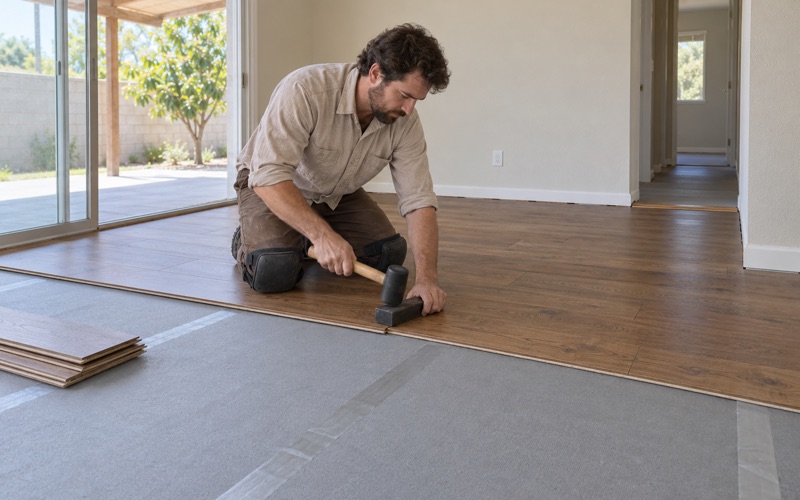
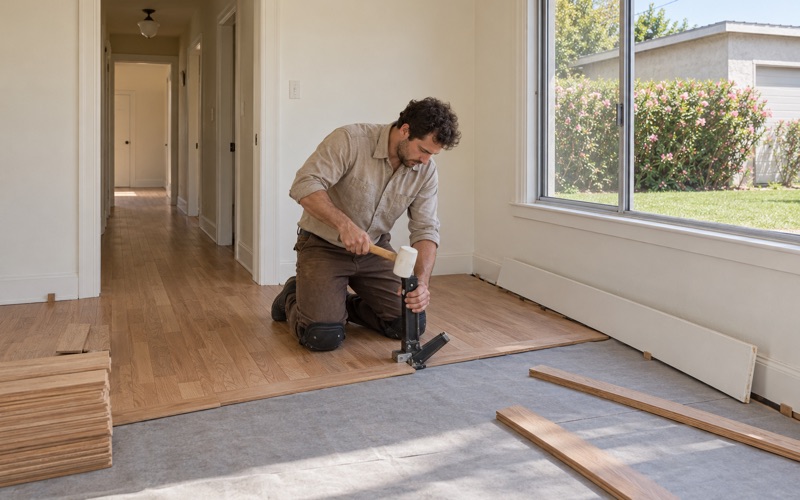
New flooring is left to acclimate in the rooms where it will be installed until its moisture content is within range of the subfloor, following NWFA installation guidelines. Rushing that step is how a floor that looked perfect at install develops gaps or cupping a few months later.
Estimates You Can Use
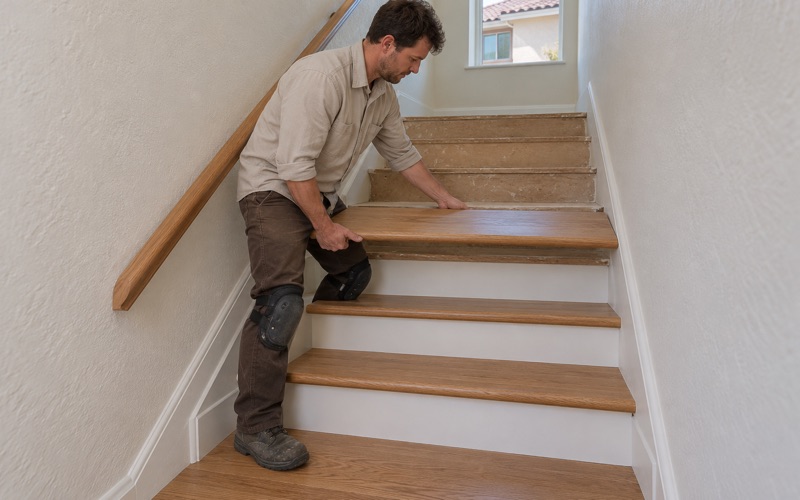
Every estimate we write separates the work into clear lines: sanding and finishing, board replacement, subfloor repair, trim such as shoe molding and reducer strips, and entry protection. Stairs are priced per tread and riser rather than folded into a square-foot number, because a staircase takes far more handwork than a hallway.
If you own a rented house and need the floors turned between tenants, we provide written estimates and invoices you can keep with your records. For owners living in the house, we plan the sequence room by room so you know which spaces are closed on which days and when the floor is safe to walk on in socks, then shoes, then furniture.
- 20+ Years on Hardwood
- Written Moisture Readings
- Lead-Safe Work Practices