Bellflower Wood Flooring brings more than 20 years of hands-on work to wood-flooring in Signal Hill, and most of the calls we take here come from homes that have reached a particular age. The floors a house was built with do not last forever, and a lot of homes in this city are now arriving at the point where they need to come up.
We start every job by finding out what is actually there. That means pulling back a corner of whatever covers the floor, reading moisture in the wood and in any concrete below it, and checking the subfloor for bounce or soft spots before a price is written. Nothing gets ordered until the readings are on paper.
From there the choice is usually between replacing a tired floor and putting real wood into a room that has never had it. Both requests are common, and both depend on the same groundwork: a sound subfloor, material that has acclimated to the house, and a finish that is legal to apply in the South Coast air basin.
Signal Hill’s Biggest Building Decade
The American Community Survey counts 4,811 housing units in Signal Hill, and 1,105 of them were built between 1980 and 1989. That is 23.0 percent of the city’s housing, more than any other decade on record. For a flooring contractor it means a large share of local homes were finished within a few years of each other and are aging on the same schedule.
The 1990s that followed added only 355 units, so the 1980s stand out clearly rather than sitting in a long, even run of construction. Counting everything from 1980 onward, 51.1 percent of the city’s units date to that decade or later. In practical terms, about half of the homes we see here are the newer half of the stock, and the oldest of that half is now due for attention.
From Oil Town to New Construction
Signal Hill was an oil town before it was much else. Oil was struck at Alamitos Well No. 1 on June 23, 1921, and the city’s housing element notes that the field produced over 1 billion barrels of oil by 1984. Oil production remained the mainstay until declining prices reduced it in the 1970s.
In 1974 the city formed the Signal Hill Redevelopment Agency to diversify away from oil. The records we rely on give the sequence rather than a cause: the agency came first, and the city’s biggest building decade followed. Either way, the homes of that decade are the ones now calling for new floors.
Counting the Housing Stock
The California Department of Finance counted 4,632 housing units in Signal Hill on January 1, 2021, a little under the survey’s total, since the two sources count in different ways. The city’s housing element describes roughly three in ten units as single-family detached homes, while the survey reports a somewhat higher share.
We do not lean on either number when planning a job. A detached house, a townhome and a unit in a larger building each bring their own access, noise and scheduling questions, and we ask about them at the first visit. The type of home shapes how the work is staged far more than any citywide percentage does.
Looking for wood-flooring closer to South Whittier? See Wood-Flooring Services in South Whittier.
What a Forty-Year-Old Floor Has Been Through
A home finished in the 1980s is now about forty years old. Whatever went down on its floors at the start has carried four decades of foot traffic, furniture, sunlight, pets and spills, and in many houses it has been patched or covered over along the way. We do not assume what is under a room until we have looked.
Reading What Is Under the Top Layer
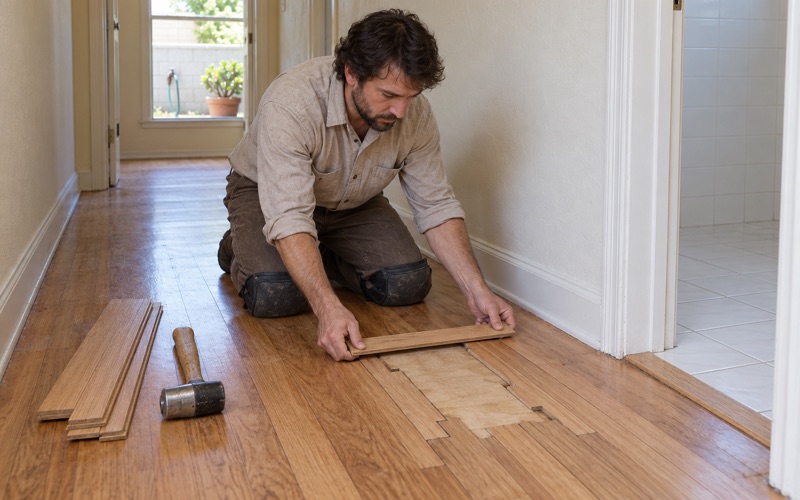
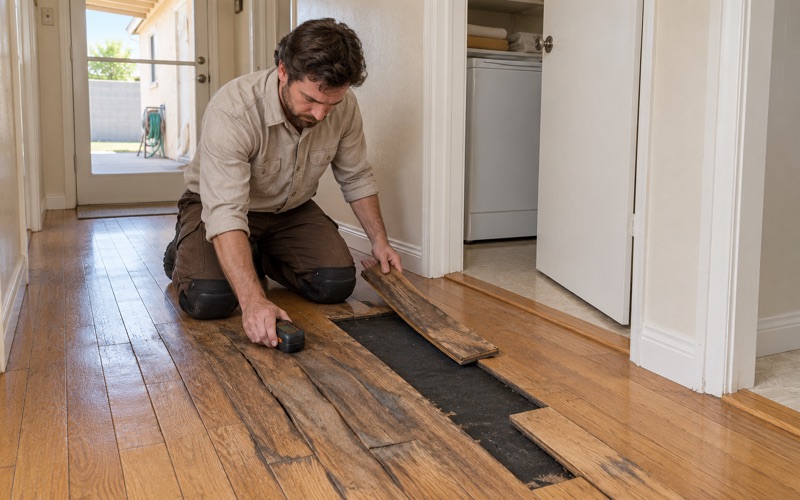
We lift a corner of carpet or a transition strip before we quote anything. Sometimes there is wood that can be saved, and sometimes there is only underlayment, a carpet tack strip line and a layer of old adhesive. If we find oak strip flooring, it is assessed board by board, because sanding and a weave-in repair often cost far less than a full replacement.
Old tile and black mastic get a different response. We treat them as a possible asbestos question and stop before anything is sanded or scraped, since SCAQMD Rule 1403 governs how suspect material is handled. An asbestos survey settles the matter, and we plan the rest of the job once the results are back.
Moisture, Cupping and Gaps
Four decades is long enough for a plumbing leak, a dishwasher failure or a slow drip under a sink to have left its mark. Cupping, crowning, buckling and board gaps usually point to moisture, and we trace each one back to its source before replacing a single plank. Where a slab leak is involved, the plumber repairs or reroutes the line first and we put the floor back afterward.
When there is an insurance claim, we document the damage with photos and moisture readings an adjuster can use. Those readings also give us a baseline for the new floor, since wood installed too wet or too dry will keep moving after it settles into the house. A written record protects the owner whether or not a claim is ever filed.
Subfloors That Have Settled
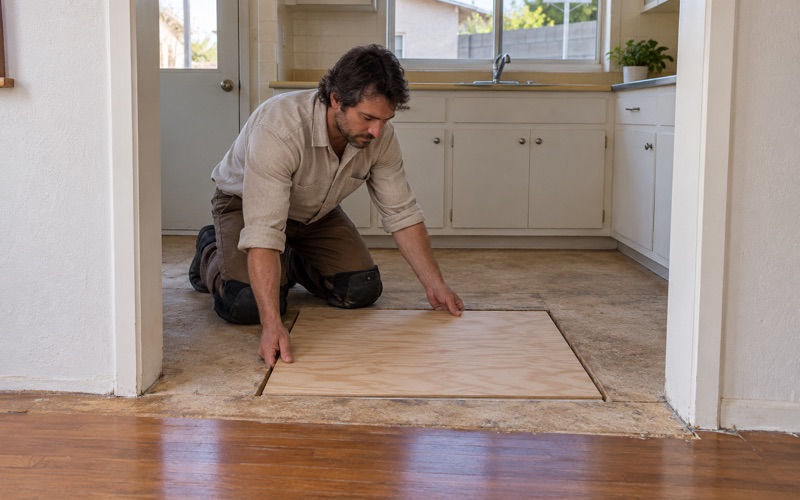
A floor that bounces or squeaks has usually been doing so for years. After forty years of use, nail pops, loose panels and soft spots in plywood or particleboard decking are ordinary findings, and we trace them to the subfloor and framing before a finish floor is priced. Fixing the structure first is what keeps a new floor quiet.
Where a framed floor has sagging joists, sistering or added blocking may be needed, and that appears as its own line on the estimate. We would rather show an owner the problem with the old floor up than hide it under new boards and have it return as a squeak within a year.
Putting Wood Into a 1980s House for the First Time
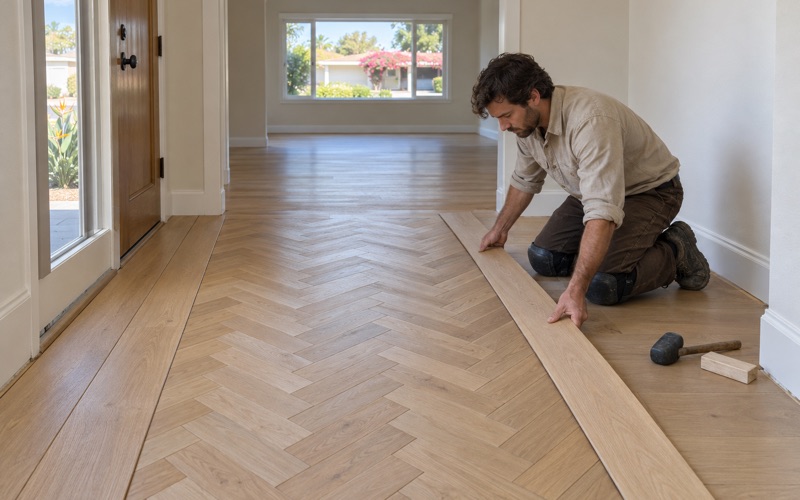
Plenty of Signal Hill owners are not replacing wood at all. They are adding it to a 1980s home for the first time, often after pulling out whatever covering the house has worn through. That changes the questions, because the right product depends on what the floor is built on and how each room will be used.
Solid, Engineered or Something Else
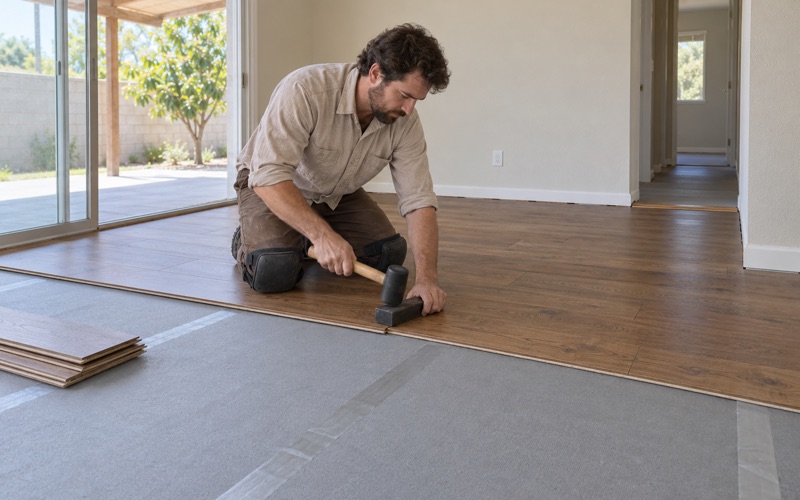
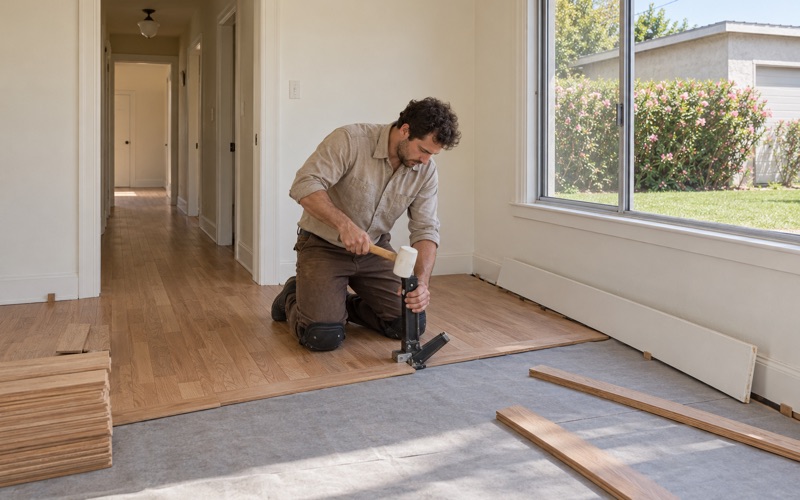
Over a concrete subfloor we usually steer toward engineered hardwood, glued down or floated, because its core construction handles moisture changes better than solid strips. Over a wood subfloor, solid white oak or red oak can be nailed down with cleat nails and site-finished in place. We compare Janka hardness ratings with each owner when pets or heavy furniture are part of the picture.
Wear layer thickness matters as much as species on engineered products. A thicker wear layer can be sanded and refinished later, which is worth weighing in a home that may see several more decades of use. Prefinished boards go in faster, while site-finished floors let us match stain and sheen to the room.
Testing Before Material Arrives
Concrete gets tested before any wood is ordered. We use an ASTM F2170 in-situ relative humidity test, or a calcium chloride moisture test where it fits, and we check the moisture content of the flooring itself with a wood moisture meter. The readings are written down so the owner keeps a copy.
Acclimation follows the numbers rather than a fixed calendar. Boards stay in the house until their moisture content sits where the NWFA installation guidelines call for relative to the subfloor, and only then do we lay the first row. A vapor retarder goes down wherever the guidelines and the product require one.
Finishes Chosen for the Air Basin
Site-finished floors need a coating that is legal to apply here. Signal Hill falls under the South Coast Air Quality Management District, and SCAQMD Rule 1113 sets a 275 g/L limit for wood coatings, so every product we choose meets it. Waterborne polyurethane and hardwax oil are common choices, each with its own look and upkeep.
We also confirm that engineered and composite products are CARB Phase 2 compliant and meet the TSCA Title VI formaldehyde limits. It is a quick check that keeps the wrong product out of a living room. Sheen level is usually the last decision, and lower sheens hide everyday scuffs better in busy rooms.
Planning Floor Work in a 1980s Signal Hill Home
Signal Hill is a compact city of about 2.2 square miles, entirely surrounded by Long Beach, yet it runs its own building department. Local work goes through the City of Signal Hill Community Development Department, Building Safety, which reviews plans, issues permits and inspects. Since October 28, 2024, that office has been temporarily located at the Council Chamber, 2175 Cherry Avenue.
Checking Permit Questions Early
Whether a project needs a permit depends on its full scope, not just the finish floor. The city publishes a handout on which work needs one, and remodeling that repairs or alters framing, electrical, plumbing or mechanical systems is on that list. When a floor job reaches the framing or moves a plumbing line, we confirm the requirement with Building Safety before work starts.
Owners, Landlords and Turnover
Signal Hill is split almost evenly between owners and renters, with 2,285 owner-occupied units and 2,260 rented. For landlords, we provide written estimates and invoices that work for a turnover between tenants, so the record of what was replaced and why is on paper. Owners get the same documentation for their own files.
We describe what we find in plain terms, separating damage from normal wear and tear. That distinction is the one a landlord has to draw when settling a security deposit under Civil Code 1950.5, and a clear written description makes it easier to explain to a departing tenant.
Homes Older Than the 1980s
Not every call comes from the peak decade. The survey dates 845 units to the 1970s, and in homes built before 1978 we follow lead-safe work practices under the EPA Renovation, Repair and Painting rule. The housing element also records estimates of 300 and 200 substandard units in its 4th and 5th cycles, a reminder to inspect before pricing anything.
How a Job Runs
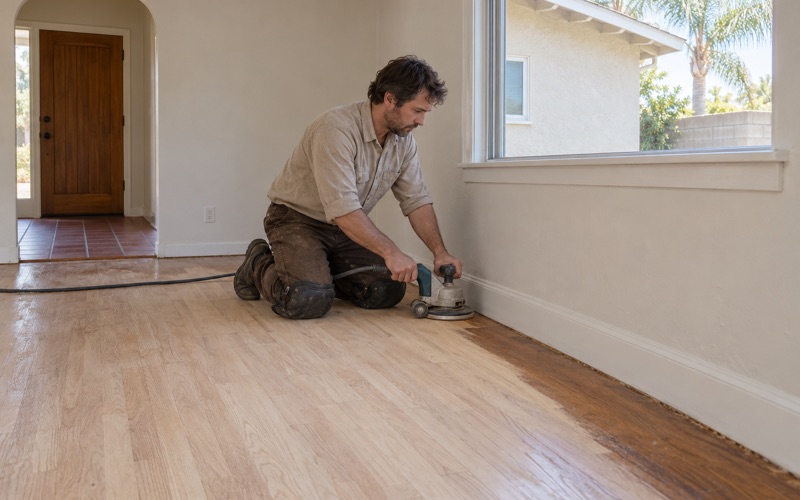
Most projects follow the same order: inspection and moisture readings, a written estimate, material delivered to acclimate, subfloor repairs, then installation or sanding and finishing. We use a dustless sanding system with a drum sander, edger and orbital sander, working through the grit sequence so the finish goes onto an even surface. Owners know each step before it happens.
For a house that has held the same floors since the 1980s, the goal is a new floor that lasts at least as long again. That comes from doing the unglamorous work first and choosing material that fits the house, rather than the other way around.
- 20+ Years on Hardwood
- Written Moisture Readings
- Lead-Safe Work Practices