
Solid hardwood flooring from Bellflower Wood Flooring gives Bellflower, CA homes a floor that can be sanded and renewed for generations, and we also install it for homeowners in surrounding cities including Paramount, Lakewood, Norwalk, Artesia and Downey. Each board is one piece of wood from face to back, which is why solid oak laid in the 1940s and 1950s is still being refinished in local houses today.
We have installed and refinished solid wood floors for more than 20 years. Every installation starts with the subfloor and a moisture reading in both the subfloor and the new boards, written on the estimate, because solid wood is the most sensitive of all flooring to the base it sits on.
Species and Board Choices
Red Oak and White Oak
Red oak is the classic American floor, with a warm tone and open grain, and it turns up often under the carpet in older houses around here. White oak has tighter grain, a cooler color and slightly higher hardness, and it takes modern gray and natural stains more evenly.
If you are adding rooms next to an original oak floor, matching the species keeps the house consistent after finishing.
Hickory and Harder Woods
Hickory is noticeably harder than oak on the Janka hardness rating and shows strong color variation from pale to dark in the same board. It suits busy households and a rustic look, though it is heavier to work and needs sharp tooling to finish well.
Strip, Plank and Width
Strip flooring is the narrow profile common in mid-century houses, while plank flooring uses wider boards. Wider solid boards move more with seasonal moisture, so they need a stable subfloor and careful acclimation. For very wide boards, engineered construction is often the safer choice.
Subfloors and Installation
Nail-Down Over Wood Subfloors
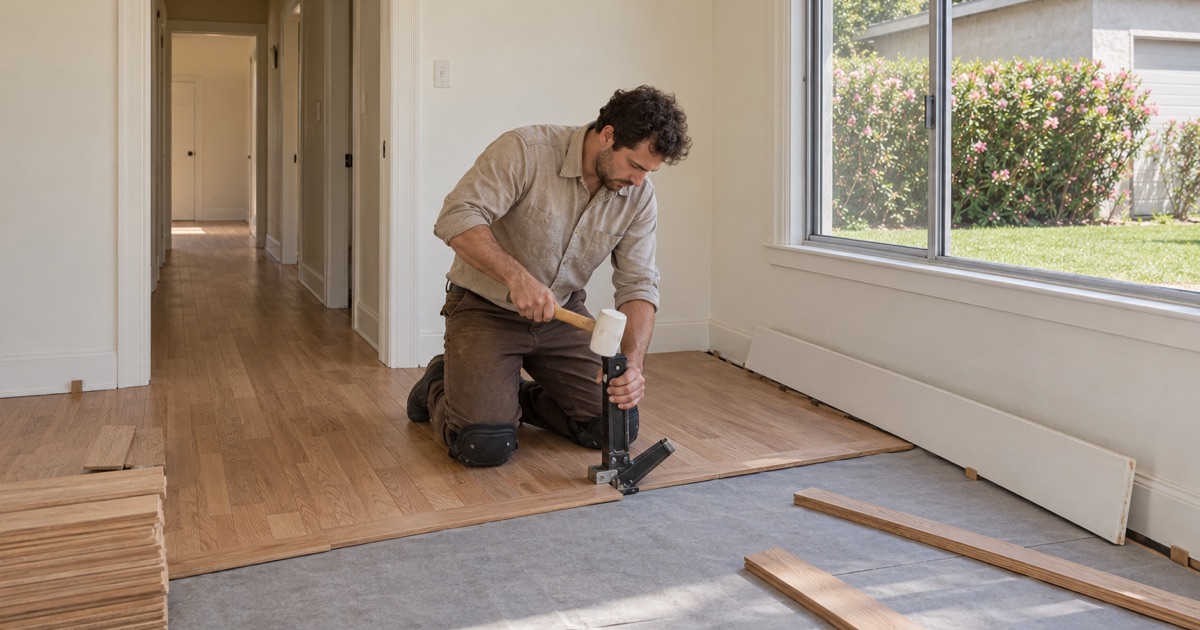
Solid hardwood is installed by nail-down installation, using cleat nails or flooring staples driven through the tongue into a plywood subfloor or board subfloor. We follow NWFA installation guidelines for fastener spacing and leave an expansion gap at every wall, hidden by base and shoe molding.
Checking the Subfloor First
Before installation, we check the subfloor for soft spots, loose boards and flatness, and tighten or replace sections as needed. On a raised foundation, we also look at the joists from the crawl space. A solid floor will telegraph every dip and squeak in the structure below, so this step decides how the floor feels for years.
Acclimation and Moisture Content
Solid boards need to reach a moisture content close to the house before they go down. We measure the boards and the subfloor with a wood moisture meter and record both. Installing boards that are too wet or too dry is a common cause of gaps and cupping in a new floor.
Site-Finished or Prefinished
Site-Finished Solid Hardwood
Site-finished hardwood is installed raw, then sanded flat and finished in place. The surface has no bevels between boards, and you can choose any stain color and sheen level. We use waterborne polyurethane or other finishes that meet the 275 g/L wood-coating VOC limit under SCAQMD Rule 1113.
Prefinished Solid Hardwood
Prefinished hardwood arrives with a factory finish, so the room can be used soon after installation with no sanding dust. The boards usually have small beveled edges, and color choices are limited to what the manufacturer offers. It is a good fit when time in the house is limited.
Living With a Solid Wood Floor
Refinishing Over the Years
The main reason to choose solid hardwood is its life span. When the finish wears, a screen and recoat refreshes it; when the wood itself is worn or scratched, a full sand and refinish takes it back to new. A solid floor can go through that cycle several times.
Moisture and Seasonal Movement
Solid wood expands in humid months and shrinks in dry ones, so small seasonal gaps are normal. Keeping indoor humidity reasonably steady and wiping up spills quickly will prevent most problems. Any sign of cupping is worth a moisture check, because it usually means water is reaching the floor from somewhere.
Solid Hardwood in Older Bellflower Houses
Extending an Original Oak Floor
The 1950s were Bellflower’s biggest building decade, and many of those houses still carry their first oak strip floors in the living room and bedrooms. When a kitchen, hallway or addition is opened up to that floor, new solid oak of the same width can be woven into the existing rows so the two read as one surface.
The new and old boards are then sanded together and finished in one pass. That is the only reliable way to get the colors to match, because new oak and decades-old oak take stain differently until both are back to bare wood.
Raised Foundations and Board Subfloors
Most houses from that era sit on a raised foundation with a board subfloor, which suits solid hardwood well. Before new boards go down, we tighten loose subfloor planks to the joists from the crawl space and cover wide gaps between them with plywood underlayment, so the new floor stays quiet and flat.
Where a sagging joist or an old leak has softened an area, that repair comes first. It is much easier to fix framing before a new floor is nailed over it than after.
Old Floor Furnace Openings
A house that once had a floor furnace often has an opening in the hallway that was later covered with plywood. When we install new solid hardwood through that area, the opening is framed and decked properly first, so the new boards run straight across it without a soft spot or a visible seam.
Safe Work Around Old Trim and Tile
Pulling baseboards and shoe molding in pre-1978 housing can disturb lead paint, so we follow lead-safe practices during that work. If old 9x9 tile or black mastic turns up in a kitchen or bath where the new floor is going, we stop and treat it as a possible asbestos question before anything is removed.
- 20+ Years on Hardwood
- Written Moisture Readings
- Lead-Safe Work Practices