Bellflower Wood Flooring handles wood-flooring in South Whittier with more than 20 years in the trade, and many of the homes we walk into here come with a longer repair list than the floor alone. A leaking line under the sink, an appliance near the end of its life and worn boards in the hallway often show up in the same conversation.
Our approach starts with measurement rather than a sample board. We read moisture in the wood and in any concrete before ordering material, trace soft spots down to the framing, and put every number in writing. Old tile and black mastic get treated as a possible asbestos question before anything is scraped, and houses built before 1978 get lead-safe practices.
This page covers how floor work fits beside the County minor-repair help available in South Whittier: what that grant is designed to handle, what it leaves to the owner, and the order that keeps one job from undoing the other. Eligibility decisions belong to the County agency that runs the program, and we point owners there rather than guess.
County Repair Help and the South Whittier House
Unincorporated County, District 4
South Whittier is unincorporated Los Angeles County territory, so no municipal government stands behind a floor project here. The Board of Supervisors governs the community, which sits in Supervisorial District 4, represented by Janice Hahn according to the County CEO annual report for FY 2023-24. County departments run the services a homeowner deals with day to day.
That report counts ten CDBG projects serving South Whittier that year, and the Handyworker Program is one of them. Administered by LACDA, it provides grants for minor home repairs to eligible low- and moderate-income households. For an owner looking at a list of small fixes and one tired floor, it is worth knowing the program exists before pricing anything.
A Housing Stock From One Decade
Census figures show 49.3 percent of South Whittier housing units were built between 1950 and 1959, and 84.3 percent went up before 1980. That concentration shapes both the repair list and the floor. Houses of that age tend to need the same small things at once, which is exactly the territory a minor-repair program targets.
For the floor, the build era means we plan for lead-safe work practices under the EPA Renovation Repair and Painting rule on any pre-1978 house. It also means old 9x9 asbestos floor tile or black mastic under a later covering is treated as a possible asbestos question, and an asbestos survey comes before anyone sands or scrapes it.
Owners Who Have Stayed Put
Of the 15,341 occupied units, 64.7 percent are owner-occupied, and 93.9 percent of owner households live in a detached house. Another 24.3 percent of owner households carry no mortgage, and 26.5 percent are headed by someone 65 or older. Those are the households most likely to be weighing a small grant against their own savings.
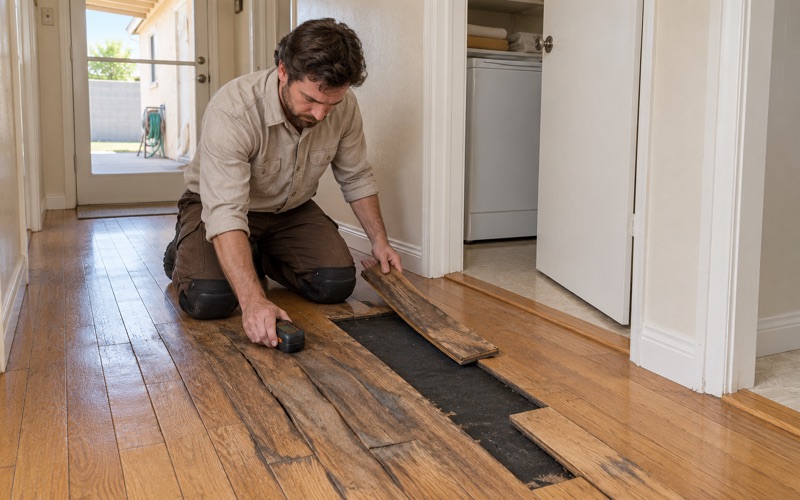
Long ownership changes how a floor project is framed. A house held for decades often has layers, carpet over linoleum over whatever went down before it, and nobody living there has seen the bottom layer in years. We lift a corner and assess what is actually there, board by board, before anyone quotes a full replacement.
Looking for wood-flooring closer to Willowbrook? See Willowbrook Wood-Flooring.
What the Handyworker Grant Is Built to Fix
The Published Repair Examples
LACDA’s Handyworker page lists its example repairs plainly: minor plumbing repairs, replacement or repair of exterior screens, installation of smoke alarms or carbon monoxide detectors, garbage disposals and appliances. The maximum grant is $9,000. Those examples describe small, discrete jobs that keep a house safe and working, the sort of fix a crew can finish quickly.
Reading that list honestly matters. It names no flooring item, and the page we read publishes no list of ineligible work either. So we do not tell anyone how the grant treats their floor. Whether a given repair fits the program is LACDA’s decision, made on its own application, and that is where the answer comes from.
Who the Program Is Written For
The program covers owner-occupied single-family homes, mobile homes, condominiums and townhomes in the unincorporated First, Fourth and Fifth Supervisorial Districts. LACDA also asks that the owner be on title, carry homeowner’s insurance and have owned the property for at least one year, with household income at or below 80 percent of Area Median Income.
The income limits effective June 1, 2026 run from $93,300 for one person to $133,250 for a household of four. We quote those only so an owner knows where to start reading. Eligibility for a specific household is decided by LACDA, and the application process is the place to find out.
Where Floors Sit Relative to the List
A floor is rarely a minor repair in the way a disposal or a smoke alarm is. Refinishing a living room or replacing boards across a hallway involves sanding, finishing, drying time and moving furniture, and the scope is larger than a single fix on the grant’s example list. That scale is why we treat the floor as its own project.
There is also a practical overlap. A minor plumbing repair under a kitchen sink or in a bathroom can reveal water that already reached the floor, and an appliance swap can expose damaged boards where the old unit sat. Those discoveries are where a floor plan and a grant-funded repair meet, and timing starts to matter.
Putting Floor Work After the Other Repairs
Let the Plumbing Settle First
When a plumbing fix is on the list, we want it done before the floor is priced. Wood near a repaired line needs time to give up moisture, and a finish floor laid over wet boards can cup, crown or buckle later. We take readings with a wood moisture meter and record the moisture content before any material is ordered.
If a slab leak is part of the picture, the plumber repairs or reroutes the line first, and then we put the floor back properly. Where water damage is involved, we trace it to its source and document it with photos and moisture readings, which gives an insurance adjuster something concrete to work from.
Appliances, Vents and Old Openings
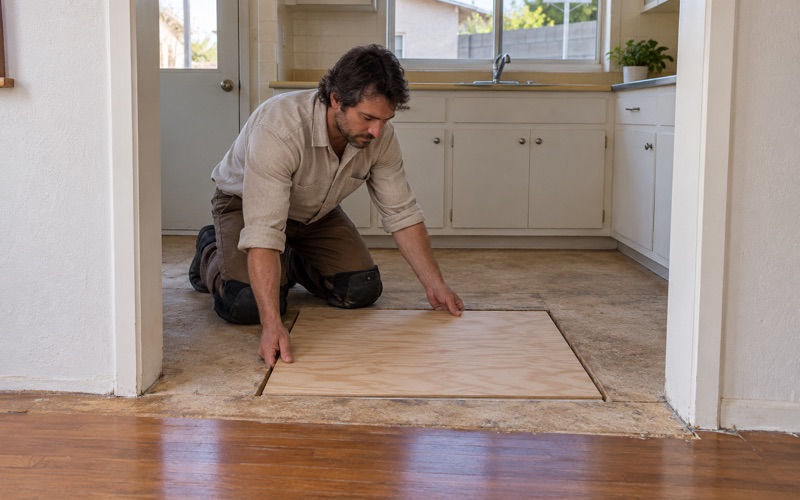
An appliance replacement is a good moment to look at the boards the old unit covered. Dishwashers and refrigerators leave stains, soft spots and cut edges that are easier to repair while the space is empty. We coordinate so the new appliance goes in after the floor under it is finished, not before.
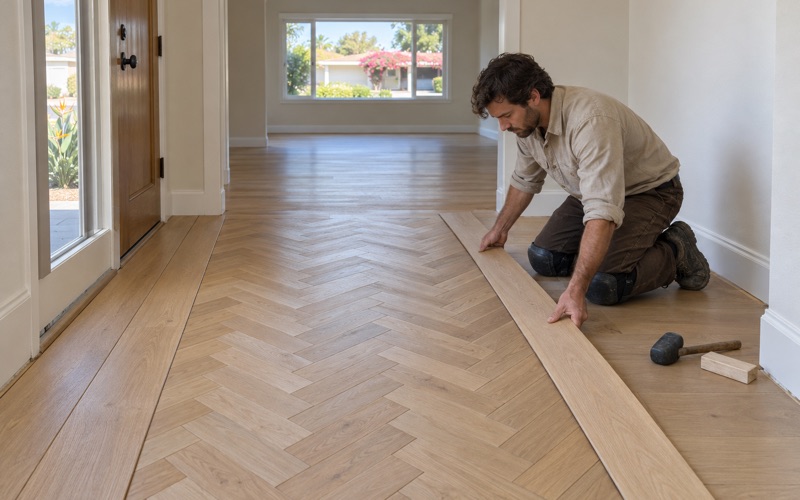
Houses from this era sometimes carry an old floor furnace opening or floor registers left from an earlier heating setup. We close those with framing and woven-in boards so the patch reads as part of the floor, rather than a plywood square hidden under a rug. That work fits naturally once the other repairs are finished.
Subfloor Before Finish Floor
Soft spots, sagging and bounce get traced to the subfloor and framing before we price any finish floor. A sagging joist may need sistering, and a damaged board subfloor or plywood subfloor has to be repaired first. Pricing the finish without that check is how estimates grow halfway through a job and surprise the owner.
The program also names mobile homes, and 41 owner households in South Whittier live in one. Mobile-home decking behaves differently from a site-built subfloor, especially where particleboard decking has taken on water, and it gets the same inspection for soft spots before any flooring decision is made.
Budgeting the Floor as Its Own Project
A Written Estimate With the Readings
We give a written estimate that separates subfloor work, material, installation and finishing, with the moisture readings recorded beside it. Where a room sits on concrete, we test that too, using a calcium chloride moisture test or an ASTM F2170 in-situ relative humidity test. That paperwork lets an owner compare the floor cost against every other repair on the list.
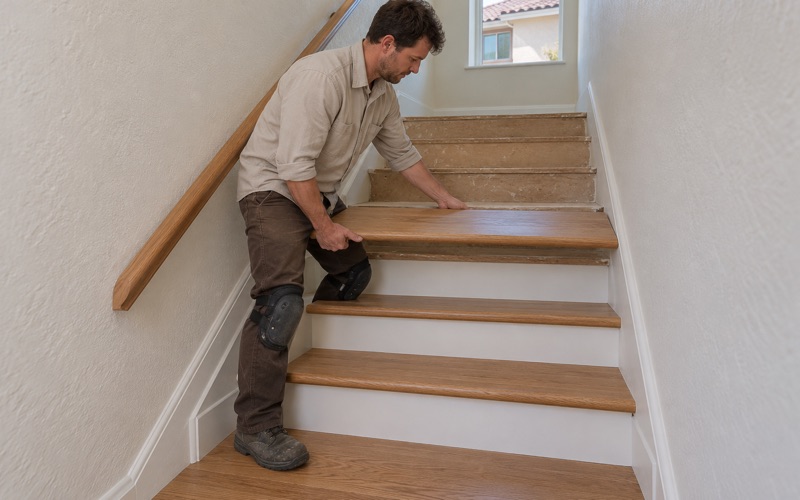
Stairs are priced per tread and riser rather than folded into a square-foot number. A staircase with worn stair nosing or loose treads is a different job from an open room, and a separate line keeps the estimate readable when an owner is deciding what to do now and what can wait a year.
Refinishing Versus Replacement
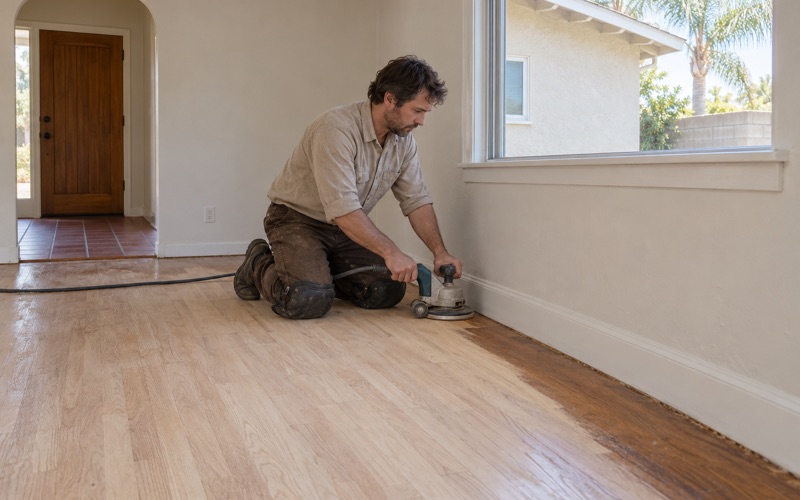
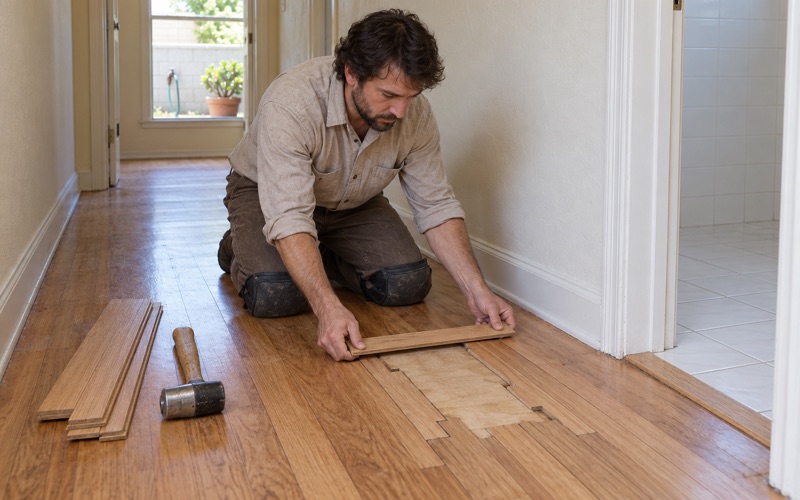
Where existing oak is sound, sanding and refinishing is usually the less expensive route, and a screen and recoat can freshen a finish that is dull but intact. Where boards are water damaged or split, board replacement and weave-in repair fix the damaged area without tearing out the rest of the room.
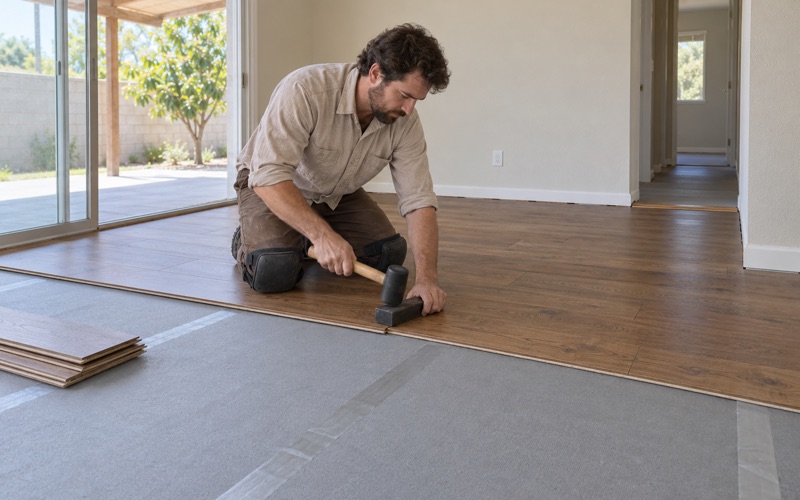
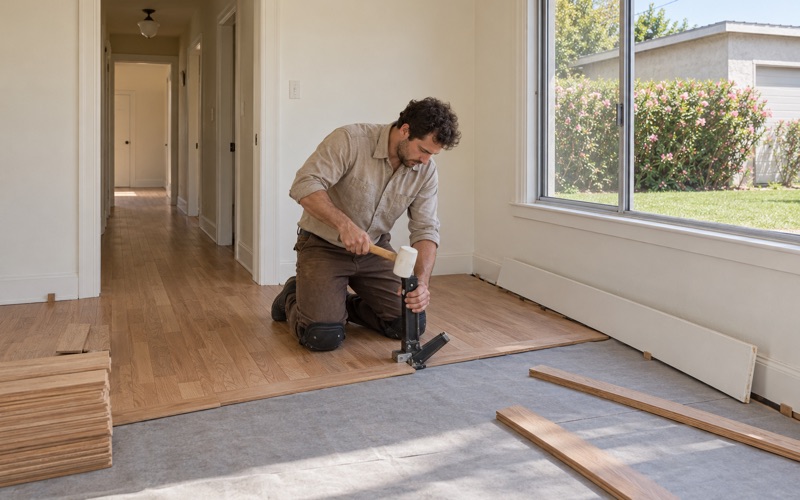
When replacement makes more sense, we talk through solid white oak or red oak, engineered core construction and wear layer thickness, and how a product’s Janka hardness rating relates to the household’s traffic. Installation follows NWFA installation guidelines, with acclimation, an expansion gap and the right nail-down, glue-down or floating method for the subfloor underneath.
Finishes, Air Rules and the County Office
Every finish we apply is chosen from products legal in the South Coast air basin under SCAQMD Rule 1113, which sets the wood coatings VOC limit at 275 g/L. Waterborne polyurethane, oil-modified polyurethane and hardwax oil each come in compliant formulas, and each carries different drying and odor tradeoffs for a house people are living in.
County Public Works handles building permits, plan checks and inspections for the community through its South Whittier Building and Safety Office at 12440 Imperial Highway in Norwalk. The County issued 768 building permits in South Whittier in FY 2023-24. When a floor project touches framing or other work that raises a permit question, that office is the place to ask.
Sequencing the Whole Plan
The order that works is simple to state. Apply for the minor repairs first if the household fits the program, let those jobs finish, then bring us in to read moisture, check the subfloor and price the floor on its own. Nothing gets sanded or installed over a repair that is still in progress.
That sequence keeps the grant doing what it is built for and keeps the new floor from being damaged by the work that follows it. It also means our estimate reflects the house as it stands after the repairs, not a guess about what the plumber or the appliance installer will find underneath.
- 20+ Years on Hardwood
- Written Moisture Readings
- Lead-Safe Work Practices